How to Verify a Chinese Company Stamp in 3 Steps (Avoid Scams)
The Stamp Is Not a Formality
In Western business, a contract is signed by a person. In China, a contract is stamped by a company. The company chop — the red circular stamp — is the legal signature of the business itself. A contract without the right stamp may not be enforceable. A contract with a fake stamp is not a contract at all.
Most overseas buyers receive a stamped contract, see the red ink, and assume it is legitimate. That assumption costs people money. Fake stamps are easy to make in China. A fraudster can carve a realistic-looking chop for under $10 and use it to sign contracts, issue authorization letters, and stamp business licenses. The red ink looks official. The company name looks right. But the stamp was never registered with the authorities, and the person using it has no connection to the real company.
Verifying a Chinese company stamp does not require a forensic lab. It requires three checks that take about ten minutes.
What a Chinese Company Stamp Actually Is
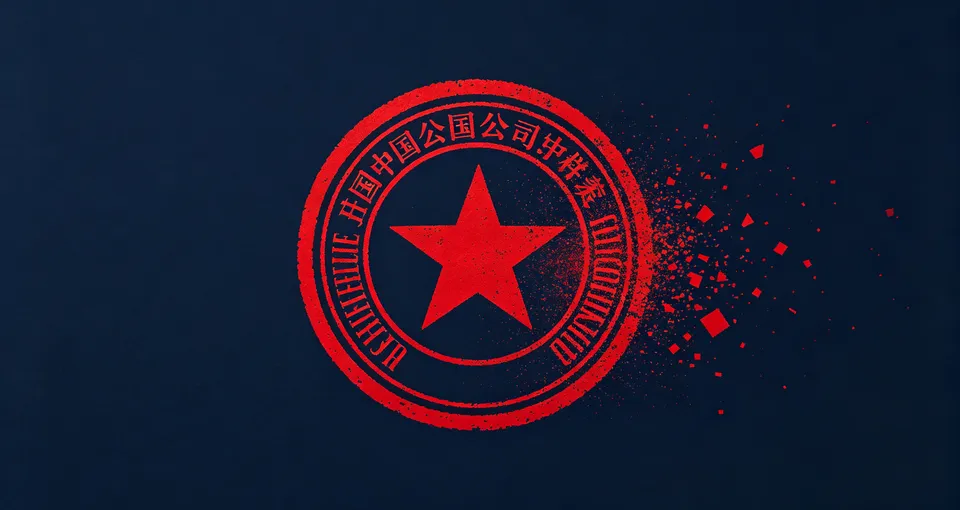
A company chop (公章, gongzhang) is the official seal of a Chinese company. It is circular, usually 4.2 cm in diameter, with a five-pointed star in the center and the company’s full registered name arranged along the circumference. When a company is registered, the chop is carved under police supervision and filed with the local public security bureau. Each legitimate chop has a traceable registration.
Chinese companies use several different stamps, and they are not interchangeable:
- Official chop (公章) — the primary company stamp. Used for all formal legal documents, contracts, and official correspondence. This is the one that matters most.
- Contract chop (合同专用章) — specifically for signing contracts. Has the same legal effect as the official chop for contract purposes. Usually includes “合同专用章” below the company name.
- Financial chop (财务专用章) — for banking, invoices, and financial documents. Should not appear on a sales contract.
- Invoice chop (发票专用章) — only for tax invoices. Not a contract stamp.
- Legal representative chop (法人章) — the personal name stamp of the legal representative. Used for banking and some government filings. Not a substitute for the company chop.
If a supplier sends you a contract stamped with a financial chop or an invoice chop, that is a problem. Those stamps are not meant for contracts. Either the supplier does not know what it is doing, or it is using whatever stamp it has because it does not have a proper company chop.
Step 1: Match the Name on the Stamp to the Registered Name
This is the most important check, and it catches more fakes than anything else.
The name on the stamp must match the company’s full registered name in GSXT — character for character. Not approximately. Not “the same meaning.” Exactly the same.
Chinese company names follow a strict format: administrative division + trade name + industry + company type. For example, “深圳市伟达电子有限公司” breaks down as Shenzhen (city) + Weida (trade name) + Electronics (industry) + Co., Ltd. (type). A fake stamp might say “深圳市伟达电子科技有限公司” — adding “科技” (technology). Or “广东伟达电子有限公司” — changing the administrative division from city to province. These look like minor differences to a non-Chinese reader, but they are different legal entities.
What to do:
- Get the supplier’s full Chinese company name and Unified Social Credit Code (USCC).
- Look it up in GSXT or ChineseVerify.
- Compare the registered name character by character against the name on the stamp.
If the names do not match exactly, stop. The stamp does not belong to the company you think it belongs to. Either the supplier is using a different entity’s stamp, or the stamp is fake. Either way, you do not have a valid contract with the company you intended.
This also catches a common scam where a fraudster registers a company with a name nearly identical to a well-known supplier, then uses that company’s stamp to impersonate them. The fake name differs by one character. GSXT shows the real name. The mismatch is the signal.
Step 2: Check the Stamp Type and Physical Details
Not every red circular stamp is a valid company chop. Look at what kind of stamp it is and whether it matches the document.
The stamp type must match the document. A sales contract should be stamped with the official chop (公章) or the contract chop (合同专用章). If you see “财务专用章” (financial) or “发票专用章” (invoice) on a sales contract, that is a red flag. A legitimate company uses the right stamp for the right document.
The stamp should be clear and consistent. A genuine stamp produces a clean, even impression. The characters are sharp and evenly spaced. A fake stamp — especially one carved quickly — may have uneven lines, smudged characters, or inconsistent spacing. This is not conclusive on its own (a real stamp can be low on ink), but combined with other signals it adds up.
The star should be in the center. Official company chops have a five-pointed star in the middle. If the stamp has no star, a different symbol, or the star is off-center, it may not be a registered company chop. Some specialized stamps use different designs, but a standard company chop always has the star.
Watch for digital stamps. An increasing number of scams use a stamp image pasted into a PDF or Word document. The stamp looks perfect — too perfect. Genuine stamps have slight imperfections from the physical stamping process: uneven ink pressure, slight rotation, minor smudging. A pixel-perfect digital stamp with no physical imperfections is likely an image file, not a real impression. Ask for a scanned copy of the originally stamped paper document, not a PDF where the stamp was inserted digitally.
None of these checks alone proves a stamp is fake. But if two or three of them line up — wrong stamp type, blurry characters, digital perfection — you are looking at a problem.
Step 3: Cross-Reference Everything Else on the Document
The stamp is one element of the document. The rest of the document should be consistent with the stamp and with the official registration record.
Legal representative. The name signed or printed on the document should match the legal representative listed in GSXT. If the contract is signed by “Zhang Wei” but GSXT shows the legal representative is “Li Ming,” either Zhang Wei is not authorized or you are dealing with a different entity. An authorized signatory who is not the legal representative is fine — but then you need a power of attorney (授权委托书) stamped by the company, and that document needs its own verification.
Registered address. The address on the document should match the GSXT registered address. It does not have to be the factory address — many Chinese companies register at an office address while operating from a factory elsewhere. But if the address on the contract is in a different city from the GSXT registration, ask why.
USCC. The Unified Social Credit Code on the document should match the GSXT record. This is the most precise identifier available. If it does not match, nothing else matters.
Bank account name. The bank account name for payment should match the company name on the stamp and the GSXT registration. If the supplier asks you to pay to a different company name or a personal account, that is a major red flag regardless of how legitimate the stamp looks.
If all of these match, the stamp is almost certainly legitimate. If any of them do not match, you have found the problem.
Common Stamp Scams
Knowing the patterns helps you spot them faster.
The name-near-miss scam. The fraudster registers a company with a name one character different from a real supplier. The stamp looks right at a glance. The USCC is different. Step 1 catches this.
The wrong-entity scam. A trading company uses its own stamp on a contract but claims to be a factory. The stamp is real, but it belongs to a trading company, not the manufacturer. The business scope in GSXT will show no manufacturing. Step 3 catches this.
The expired-entity scam. A company that has been deregistered or revoked still has physical stamps. Someone finds them and uses them to sign new contracts. The stamp is genuine — it was once registered — but the company no longer legally exists. GSXT will show the status as “dereged” or “revoked.” Step 1 and Step 3 catch this.
The digital-stamp scam. A fraudster copies a stamp image from a real company’s website or public document, pastes it into a fake contract, and sends it to you. The stamp image is real, but it was not physically stamped on your document. The document itself is fabricated. Asking for a scanned original and checking for physical imperfections helps here.
The department-stamp scam. The supplier stamps the contract with a departmental stamp (业务专用章, “business special stamp”) or a branch office stamp instead of the official company chop. These may have limited internal authority but do not carry the same legal weight as the company chop. If the dispute goes to court, the other side can claim the department had no authority to sign.
What to Do When a Stamp Fails Verification
If any check fails, do not pay. Ask the supplier for clarification. A legitimate company will be able to explain a discrepancy — for example, if the contract is signed by a subsidiary, they should tell you that upfront and provide the subsidiary’s registration details. A fraudster will give evasive answers, pressure you to pay quickly, or disappear.
If the supplier cannot provide a valid company stamp, cannot match the GSXT name, or cannot explain discrepancies, walk away. There are over 40 million registered companies in China. You have options.
For high-value contracts, consider having the stamped contract notarized by a Chinese notary office (公证处). Notarization adds a layer of official verification, though it adds cost and time. For most orders under $50,000, the three-step check plus a GSXT verification report is sufficient.
ChineseVerify and Stamp Verification
ChineseVerify does not verify stamps directly — a stamp is a physical object, and only an in-person inspection or notarization can confirm its authenticity with certainty. What ChineseVerify does is give you the official data to run all three steps: the exact registered company name, the USCC, the legal representative, the registered address, the business scope, and the operating status.
When you receive a stamped contract, pull the company’s ChineseVerify report and compare every field. The name on the stamp, the name on the contract, the USCC, the legal representative, the address — all should match the official record. If they do, the stamp is consistent with a legitimate company. If they do not, you have found the discrepancy before you paid.
Look up a Chinese company’s official registration record →
The Bottom Line
A Chinese company stamp is not a decoration. It is the legal signature of the company, and a fake stamp means your contract is worthless. But verifying one is not complicated.
Match the name on the stamp to the GSXT registered name, character for character. Check that the stamp type matches the document and that the physical details look right. Cross-reference the legal representative, address, USCC, and bank account name against the official record. If everything matches, you are dealing with a real company. If anything does not, stop and ask.
The red ink looks official. The data tells you whether it actually is.
Verify a Chinese company’s registration before you sign →
More reading:
- What Your Chinese Supplier’s USCC Number Reveals (And Why Scammers Fear It)
- GSXT Supplier Verification: What China’s Official Registry Can and Cannot Prove
- USCI Number Explained: China’s 18-Digit Business ID
- Should I Pay a Chinese Supplier’s Personal Bank Account?
FAQ
Is a stamped Chinese contract legally binding without a signature?
In China, a contract stamped with the company’s official chop or contract chop is generally legally binding even without an individual’s signature. The chop represents the company’s legal intent. This is different from Western systems where a personal signature is the primary indicator. However, having both a stamp and an authorized signature is stronger.
Can I verify a Chinese company stamp online?
You cannot verify the physical authenticity of a stamp online. What you can do is verify that the company named on the stamp exists, is active, and that the details on the document match the official registration record. If the name, USCC, legal representative, and address all match GSXT, the stamp is consistent with a legitimate company. If they do not match, the stamp is wrong regardless of how real it looks.
What is the difference between a company chop and a contract chop?
The official company chop (公章) is used for all formal legal documents. The contract chop (合同专用章) is specifically for signing contracts and has the same legal effect for that purpose. Both are valid for contracts. A financial chop (财务专用章) or invoice chop (发票专用章) is not valid for sales contracts.
What should I do if the stamp name does not match the GSXT name?
Stop and ask the supplier for an explanation. A legitimate supplier may be using a subsidiary or a related entity, in which case they should disclose this and provide that entity’s registration details. If the supplier cannot explain the mismatch, becomes evasive, or pressures you to pay anyway, walk away. A name mismatch means you do not have a valid contract with the company you intended.
How can I tell if a stamp is digital vs. physical?
A physically stamped document has slight imperfections: uneven ink pressure, minor smudging, slight rotation of the stamp, and variations in how the ink absorbed into the paper. A digital stamp pasted into a PDF is often pixel-perfect with no physical imperfections. If the stamp looks too clean and uniform, ask the supplier to send a scanned copy of the originally stamped paper document rather than a digitally generated PDF.
Do I need to notarize every Chinese contract?
No. For most standard purchase orders, the three-step stamp verification plus a GSXT check is sufficient. Notarization by a Chinese notary office adds certainty for high-value contracts or long-term agreements, but it adds cost and requires the parties to appear in person in China. Use it for contracts above your risk threshold, not for every order.
Published by the ChineseVerify Team