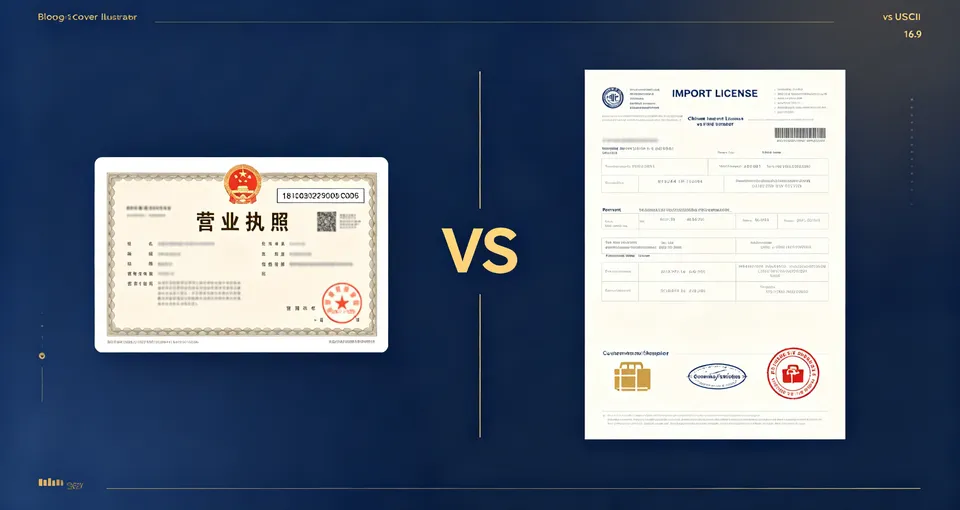
Import License vs USCC Number in China: They Are Not the Same (And Why It Matters)
The Question That Comes Up Every Week
You ask a supplier for their company registration. They send you a business license. You look at it, see the 18-digit Unified Social Credit Code (USCC), and think: okay, they are a real company, they can import and export, everything checks out.
That last part is wrong.
The USCC proves the company exists. It does not prove the company can legally export what you are buying. It does not prove the company has an import license. It does not even prove the company has registered with customs. These are separate registrations, separate numbers, and separate government departments.
Confusing them is one of the most common and most expensive mistakes overseas buyers make. You pay a deposit to a company that is legally real but has no right to export your goods. Then the goods get held at customs, or the supplier has to route the shipment through a third-party trading company you have never heard of, and suddenly your order is in the hands of an entity you never vetted.
This article sorts out the different numbers, what each one actually means, and how to check whether your supplier has the trade qualifications it claims to have.
USCC: The Company ID, Nothing More
The Unified Social Credit Code (统一社会信用代码) is an 18-digit number assigned to every registered company in China by the market regulator (SAMR). It is printed on the business license. It is the company’s legal identity number — the Chinese equivalent of a tax ID or company registration number.
Terminology note: You will see this same 18-digit code called both USCC (Unified Social Credit Code) and USCI (Unified Social Credit Identifier). They are the exact same number — two different English abbreviations for the same Chinese government identifier. This article uses USCC, but if another source or supplier refers to USCI, it means the same thing.
What the USCC proves:
- The company is legally registered
- The company’s registered name, address, legal representative, and business scope
- The company’s current operating status (active, revoked, deregistered, etc.)
What the USCC does not prove:
- That the company has the right to import or export goods
- That the company is registered with Chinese customs
- That the company holds any product-specific import or export licenses
- That the company has ever actually exported anything
A company can have a valid USCC and zero trade qualifications. It can be a domestic-only trading company, a local restaurant, a software firm — all have USCCs, none necessarily have export rights.
Import License: A Permit for Specific Goods
An import license (进口许可证) is a permit issued by the Chinese Ministry of Commerce or another relevant authority for the import of specific categories of goods. It is not a company-level qualification. It is a shipment-level or product-level permit.
Key facts about import licenses:
- Not every company needs one. Most consumer goods, electronics, clothing, and general merchandise do not require an import license. Only goods under state license management — certain agricultural products, chemicals, ozone-depleting substances, endangered species, weapons, and specific industrial products — require one.
- It is product-specific. A license for importing frozen chicken does not cover importing chemicals. Each license describes the exact commodity, quantity, and origin.
- It is time-limited. Import licenses are valid for a fixed period, often tied to a specific shipment. They are not a permanent company credential.
- The license number is its own thing. It follows a format set by the issuing authority and has nothing to do with the USCC.
If your supplier is selling you goods that require an import license on the Chinese side, you need to see that license — and the license number, company name, and product description need to match the deal. A USCC does not substitute for this.
The Other Numbers You Will Encounter
To make this more confusing, Chinese foreign trade involves several registration numbers, each from a different department. Here is the full set.
Customs Registration Code (海关注册编码, 10 digits) Issued by the General Administration of Customs. A company must have this to declare imports or exports in its own name. Without it, the company cannot clear customs directly — it has to use a third-party customs broker or trading company. This is probably the single most important qualification for an exporter, and it is not on the business license.
Foreign Trade Operator Filing Number (对外贸易经营者备案登记表编号) Issued by the Ministry of Commerce. Before a company can engage in foreign trade, it files with the commerce bureau. This filing used to be a formal approval; now it is a registration, but it is still required. The filing number is on the registration form, not the business license.
Inspection and Quarantine Registration Number (检验检疫备案号) Issued by the customs administration (formerly CIQ) for goods subject to mandatory inspection. Relevant for food, cosmetics, toys, electrical products, and other regulated categories.
Import/Export License Numbers As described above — product-specific permits for goods under license management.
None of these are the USCC. None of them appear on the standard business license. A supplier can show you a perfectly valid business license and still be missing every one of these trade registrations.
What This Looks Like in Practice
Here is a common scenario.
You find a supplier on 1688. It has a business license, a valid USCC, an active status. The business scope says “sales of electronic products” or “domestic trade.” You place an order.
When it is time to ship, the supplier says it will use a “partner trading company” for export. You agree — it sounds normal. The invoice comes from a different company name. The bank account is different. The customs declaration is filed by an entity you have never checked.
What happened? Your supplier is a domestic company. It has no customs registration code and no foreign trade filing. It cannot export in its own name, so it routes every order through an unrelated trading company that charges a fee. You are not actually buying from the company you vetted. You are buying from whoever that trading company is.
This is not always fraud. Many legitimate Chinese factories do not hold their own export rights and use trading companies. But you need to know this is happening, and you need to vet the trading company too. If the supplier hides it or lies about having export qualifications, that is a red flag.
How to Check Whether Your Supplier Can Actually Export
You cannot tell from the business license alone. Here is what to do.
1. Check the business scope on the business license. Look for “进出口” (import and export) or “货物进出口” (goods import and export) in the business scope. If it is not there, the company is not registered to conduct foreign trade. This is the quickest first check, but it is not conclusive — having the words in the scope does not guarantee the company has completed the actual customs and commerce filings.
2. Ask for the customs registration code (10 digits). A company that exports in its own name has one. Ask for it. Then verify it — you can look it up through Chinese customs public channels, or use a service that aggregates customs filing data. If the supplier cannot provide a 10-digit customs code, it cannot clear customs in its own name.
3. Ask for the foreign trade operator filing. This is a registration certificate from the commerce bureau. A company engaged in export should have it. If they cannot produce it, they are not a registered foreign trade operator.
4. For regulated goods, ask for the specific license. If the product requires an import or export license, ask for the license document and verify the license number, product description, and validity period against the issuing authority.
5. Check customs trade records. If a company has been exporting, there are customs records. You can check whether the company name appears in export shipment data. A company that claims to be an experienced exporter but has zero customs records is either lying or routing everything through third parties.
What ChineseVerify Can Do
ChineseVerify does not issue import licenses or customs codes — those come from Chinese government authorities. What it does is give you the official data to run the checks above.
- Business license and USCC verification — confirm the company is real, active, and that the license document is genuine.
- Business scope in English — see whether “import and export” is in the registered scope, translated into terminology you can read.
- Customs filing data — check whether the company has a customs registration and whether it has actual export records.
- Risk data — litigation, penalties, abnormal operations, and dishonest execution records that may affect whether the company is a reliable trade partner.
If the company has no customs registration and no export records, ChineseVerify will show you that. You will know before you pay whether you are dealing with a direct exporter or a domestic company that will route your order through someone else.
Check a Chinese supplier’s registration and trade qualifications →
The Bottom Line
The USCC is a company identity number. An import license is a product-specific permit. They are not the same thing, and neither one substitutes for the other. A valid USCC tells you the company exists. It does not tell you the company can export.
Before you pay, confirm the company has the trade qualifications the deal requires: a customs registration code, a foreign trade filing, and — for regulated goods — the specific import or export license. If the supplier cannot or will not provide these, assume it cannot export in its own name and find out who actually will.
Knowing which number means what is the difference between paying a verified exporter and wiring money to a domestic reseller you have never heard of.
Verify a Chinese company’s full registration and trade profile →
FAQ
If a company has “import and export” in its business scope, does that mean it can export?
It means export is within its registered legal scope, which is a necessary precondition. But the company still needs to complete the foreign trade operator filing and customs registration to actually export. Business scope is the first check, not the last.
My supplier says it uses a trading company for export. Is that a problem?
Not necessarily. Many legitimate Chinese factories do not hold their own export rights. But you need to know the trading company’s name, verify that company too, and make sure your contract and payment account align with the entity that is actually exporting. If the supplier hides this arrangement or refuses to identify the trading company, that is a red flag.
What is the difference between a customs registration code and a USCC?
The USCC (18 digits) is the company’s general legal identity, issued by the market regulator. The customs registration code (10 digits) is a separate registration with Chinese customs that allows the company to declare imports and exports in its own name. A company can have a USCC but no customs code — that means it exists but cannot clear customs directly.
Do all exported goods from China require an export license?
No. Most goods — electronics, clothing, furniture, general consumer products — do not require an export license. Export licenses apply only to specific categories under state management, such as certain minerals, chemicals, agricultural products, and dual-use items. For most buyers, the relevant qualification is the customs registration and foreign trade filing, not a product-specific license.
How can I verify a customs registration code?
You can check it through Chinese customs public inquiry channels, though these are Chinese-only and may be difficult to access from overseas. Alternatively, use a verification service like ChineseVerify that includes customs filing and export record data in its company reports.
More reading
- What Your Chinese Supplier’s USCC Number Reveals (And Why Scammers Fear It)
- USCI Number Explained: China’s 18-Digit Business ID
- How to Check a Chinese Company’s Business Scope
Published by the ChineseVerify Team