Are China's Tax ID, Enterprise ID, and USCI the Same Number?
1. You Asked for a Tax ID. They Sent You an 18-Digit Code.
This scene plays out in import offices every week.
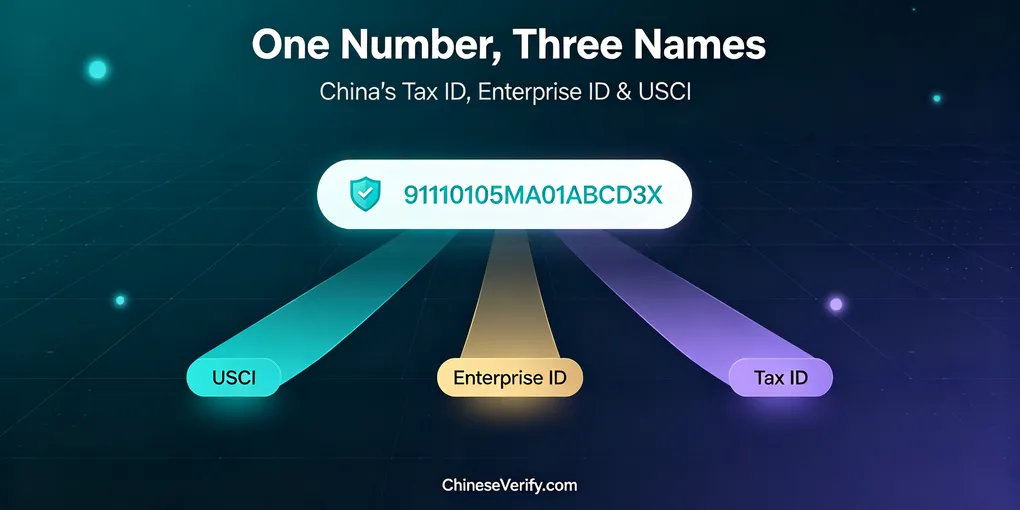
You email a Chinese supplier and ask for their tax ID so your accounting team can set them up in your system. Back comes a scan of the business license, with an 18-character code near the top — digits and uppercase letters mixed together, something like 91110105MA01ABCD3X. You cross-check the purchase order and notice the contract calls the same string an “enterprise ID.” Your customs broker calls it a USCI.
Same number. Three names. At this point you’re not sure if you’re dealing with three different things or one thing wearing three labels.
Short answer: one thing. In China, the tax ID, the enterprise ID, and the USCI are the same 18-digit number. Any company registered after 2015 carries one code that covers all three. This post explains why that happened, what the old numbers look like, and how to check that the code on your supplier’s license belongs to a real, active company — not a string someone typed onto a fake document.
2. Why Three Names for One Number?
The short version: three agencies used to issue three separate numbers, and the government merged them.
| Name | Full form | Issued by | Status |
|---|---|---|---|
| USCI / USCC | Unified Social Credit Identifier / Code | SAMR, since the 2015 “three certificates in one” reform | The current number |
| Enterprise ID / Registration No. | Business registration number | Old industry & commerce bureau, pre-2015 | Replaced by USCI |
| Tax ID / Tax Registration No. | Tax registration number | Old tax authority, pre-2015 | Replaced by USCI |
Note: Some overseas buyers use “Enterprise ID” as a casual name for the USCI itself, not for the old registration number. If your supplier’s document says “Enterprise ID” followed by an 18-digit code, it’s almost certainly the USCI.
Before October 2015, a Chinese company ran on three identifiers at once: a 15-digit business registration number from the industry and commerce bureau, a 9-digit organization code from the quality inspection authority, and a separate tax registration number. Every time the company dealt with a different government office, it had to produce a different number. It was as awkward as it sounds.
In 2015 the State Council rolled out the “three certificates in one” reform. New registrations got a single 18-character code — the USCI — that replaced all three at once. Existing companies had until the end of 2017 to convert. Today the USCI is the tax number, the enterprise ID, and the registration number.
So when your supplier says “tax ID,” “enterprise ID,” or “USCI,” they’re almost certainly referring to the same thing. If the number differs between the invoice, the license, and the bank account — that’s not a naming quirk, that’s a reason to stop and ask questions.
3. What About Those 15-Digit Numbers?
If you’ve been importing for a while, you may have seen a 15-digit registration number on an older license. All digits, no letters, no organization code embedded.
That number is retired. The conversion deadline passed at the end of 2017. We broke down the difference between the USCI and the business license number here. A supplier handing you a 15-digit number in 2026 is either showing an expired license, skipped the mandatory conversion, or the document isn’t what it claims to be. None of those are good signs.
One compatibility note: the old 9-digit organization code lives on inside the new USCI, in positions 9 through 17. That was a deliberate design choice so legacy systems could match old and new records. You don’t need to act on that — just know that the 18-digit format is the one that matters now. Always ask for the full USCI.
4. Four Quick Checks Before You Trust the Number
You can’t confirm a company exists just by looking at the string. But you can filter out sloppy forgeries in about a minute:
- Length. It must be exactly 18 characters — no more, no less.
- Character set. Digits and uppercase letters only — and never the letters I, O, Z, S, or V. Those five are banned because they look too much like numbers. Spot one and the code is invalid.
- Structure. Position 1 identifies the registering agency (9 = SAMR, the business registry), position 2 the entity type (1 = enterprise, 2 = sole proprietor), and positions 3–8 the district (110105 = Beijing, Chaoyang).
- Check digit. The 18th character is a checksum calculated from the first 17, using the algorithm defined in national standard GB 32100-2015.
Here’s the part most people miss: a valid check digit proves the string is internally consistent — it does not prove the company exists. You can generate a USCI with a perfect checksum that belongs to nobody. Format checks catch typos and lazy fakes. They don’t tell you whether the company is registered, active, or even real. Only a lookup against official data does that.
5. Verifying It Yourself vs. Using a Tool
The official source is the National Enterprise Credit Information Publicity System, known as GSXT, run by SAMR. Every registered company’s record is in there.
If you want to try it yourself from outside China, here’s what you’re in for:
- The whole site is in Chinese. No English toggle that works. You can find the company and still not know if its status means “active” or “revoked.”
- It’s slow from overseas. Pages take a long time to load, searches time out, and connections drop. A VPN helps sometimes and hurts other times.
- You need exact input. GSXT accepts only the full Chinese legal name or the complete 18-digit USCI. No English trade names, no partial matches. Most overseas buyers only have the English trading name, which is useless there.
- Chinese-character CAPTCHAs. If you can’t read Chinese, you can’t solve them.
It’s free and authoritative. It’s also a wall for anyone who doesn’t read Chinese and isn’t sitting in China.
ChineseVerify runs the same lookups against the same official government databases, but from inside China — no CAPTCHA walls, no overseas timeouts. You type an English or Chinese company name (or paste a USCI), it validates the format, queries the registry, and hands you an English report in about two minutes. That’s the path most overseas buyers end up taking.
Try it: search a Chinese company by name or USCI — free basic results, full report from $9.
6. FAQ
Is the USCI the same as the tax ID in China?
Yes. Since the 2015 reform, the USCI is the tax registration number, the business registration number, and the organization code all in one. When a supplier gives you a “tax ID,” it should match their USCI.
What if my supplier gives me a 15-digit number?
Ask for the 18-digit USCI. The 15-digit format was retired at the end of 2017. If they can’t produce a current USCI in 2026, pause and dig deeper.
Can I use the USCI as the tax ID on customs forms?
Yes. It’s the official tax number for the company, so it’s what customs and tax authorities expect to see.
Does the USCI change if the company moves or renames?
No. Once assigned, the code is permanent. A company can move, rename, or restructure without changing its USCI.
How do I verify a Chinese USCI from outside China?
Visit the National Enterprise Credit Information Publicity System (GSXT) directly, or use a verification service that queries official Chinese government databases on your behalf.
7. The Bottom Line
Don’t let three names throw you. In China, the USCI, the enterprise ID, and the tax ID are the same 18-digit number for any company registered after 2015. The real question is never which name to use — it’s whether that number actually belongs to a real, active company that’s doing what it claims.
A format check gets you partway. A registry lookup gets you the rest: registration status, legal representative, business scope, and any risk flags like abnormal operations or administrative penalties. If you’re about to send a deposit to a new supplier, that’s the check worth running.
Verify a Chinese company now →
Or see a sample report first.
More reading
- USCI Number Explained: China’s 18-Digit Business ID and How ChineseVerify Works
- USCI (USCC) vs Business License Number: What Is the Difference?
- What Does “Abnormal Operation” Mean on a SAMR Record?
Published by the ChineseVerify Team