USCI (USCC) vs Business License Number: What Is the Difference?
Two Terms, One Document
You receive a Chinese business license. Somewhere on it there is a long number. Your supplier calls it the “business license number.” Your compliance team asks for the “USCI” or “USCC.” A third source refers to the “registration number.” Are these the same thing?
Sometimes yes, sometimes no — and the difference matters if you are trying to verify a company.
The short version: USCI and USCC are two abbreviations for the same 18-character code. That code is the current, mandatory identifier for every registered entity in mainland China. “Business license number” is an older term that technically refers to a 15-digit number that was retired in 2017. Many people still use it casually to mean whatever number is printed on the license — which today is the USCI.
If you only remember one thing, remember this: the 18-character USCI is the only number that counts in 2026. A 15-digit “business license number” is a sign you are looking at an expired or outdated document.
What the Old “Business License Number” Was
Before October 2015, a Chinese company carried three separate identification numbers, each issued by a different government department:
- Business registration number (注册号) — 15 digits, all numbers, issued by the AIC (Administration for Industry and Commerce). This is what people meant by “business license number.” It was printed on the business license and identified the company in the commercial registry.
- Organization code (组织机构代码) — 9 characters, issued by the quality inspection authority. Used for statistical and administrative purposes.
- Tax registration number (税务登记号) — issued by the tax bureau. Used for filing taxes and issuing invoices.
A company needed all three. They appeared on different documents, followed different formats, and were maintained in separate databases. If you wanted to verify a supplier, you had to cross-reference three numbers across three systems. For overseas buyers who did not speak Chinese, this was effectively impossible without a local partner.
The 15-digit business registration number itself was straightforward — all digits, no letters, no embedded structure beyond a regional prefix. It did not include the organization code or any check digit. It was simply a sequential registry number.
The 2015 Reform: “Three Certificates in One”
In 2015, the State Council launched the “Three Certificates in One” (三证合一) reform. The goal was to merge the business license, organization code certificate, and tax registration certificate into a single document with a single number.
That number is the Unified Social Credit Code — 统一社会信用代码 in Chinese. In English it is abbreviated as either USCC (Unified Social Credit Code) or USCI (Unified Social Credit Identifier). Both refer to the exact same 18-character identifier. The difference is just which English translation a given source prefers.
Key facts about the transition:
- New registrations after October 1, 2015 automatically received an 18-character USCI.
- Existing companies had until December 31, 2017 to exchange their old licenses for the new unified format. The transition was mandatory.
- After the deadline, the old 15-digit registration numbers and the separate organization code / tax numbers were no longer valid for official use.
For companies that existed before 2015, their old 9-digit organization code was typically embedded directly into positions 9 through 17 of the new USCI. This made it possible for legacy systems to cross-reference old and new identifiers, but it did not make the old numbers valid for new transactions.
Anatomy of the 18-Character USCI
A USCI is not random. Every position encodes something. Here is a typical example, broken into segments:
9 1 110105 MA01ABCD 3 X
| Position | Length | What It Encodes |
|---|---|---|
| 1 | 1 char | Registration authority. 9 = SAMR (State Administration for Market Regulation), the business registry. Other digits point to civil affairs, institutional reform commissions, and other agencies. |
| 2 | 1 char | Entity type. 1 = enterprise, 2 = individual business, 3 = farmer cooperative, 5 = social group / NGO, 9 = government institution. |
| 3–8 | 6 chars | Administrative division — province, city, district. 110105 = Beijing, Chaoyang District. Same coding system used on Chinese ID cards. |
| 9–17 | 9 chars | Organization code — the unique serial number. For pre-2015 companies, this is usually their old organization code. |
| 18 | 1 char | Check digit — a MOD 31-2 checksum per national standard GB 32100-2015. Catches typos and transcription errors. |
Two practical notes:
- The letters I, O, Z, S, V are never used in a USCI. They look too much like digits or each other. If you see one of these letters, the code is malformed.
- A valid check digit proves the 18 characters are internally consistent. It does not prove the company exists. You can generate a USCI with a perfect checksum that belongs to nobody. Always verify against the official registry.
Why People Still Say “Business License Number”
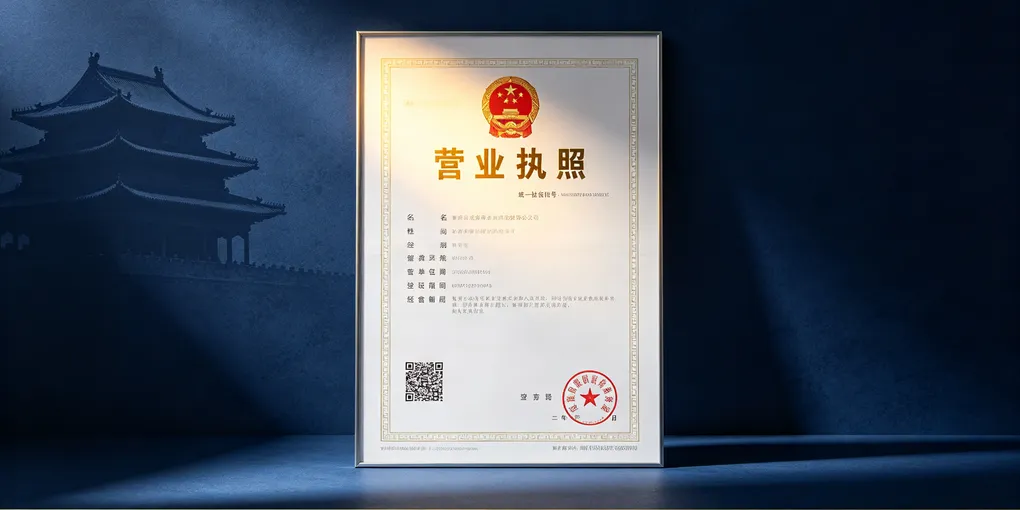
Here is where the confusion comes from. The USCI is printed on the business license. It is the number you see when you look at the document. So a lot of people — suppliers, agents, even some accountants — call it the “business license number” out of habit. They mean “the number on the business license,” which happens to be the USCI.
This is technically imprecise but common. In everyday conversation, if a Chinese supplier says “my business license number is 91110105MA01ABCD3X,” they are giving you their USCI. The number itself is what matters, not what they call it.
The problem arises when someone is referring to the old 15-digit registration number and still calls it the “business license number.” If a supplier hands you a 15-digit all-number code and calls it their business license number, they are showing you an obsolete identifier. The company may still exist — it almost certainly has a USCI now — but the document they sent you is outdated, and the number cannot be used to look up current registry data.
Side-by-Side Comparison
| Old Business License Number | USCI / USCC | |
|---|---|---|
| Format | 15 digits, all numbers | 18 characters, digits + uppercase letters |
| Issued by | AIC (old industry and commerce regulator) | SAMR (current market regulation authority) |
| Introduced | Pre-2015 system | October 2015 onward |
| Valid today? | No — retired December 31, 2017 | Yes — current mandatory standard |
| Serves as tax number? | No — separate tax registration number existed | Yes — USCI is also the tax number |
| Serves as organization code? | No — separate organization code existed | Yes — USCI embeds the organization code |
| Has check digit? | No | Yes (position 18, MOD 31-2) |
| Covers which entities? | Companies only | Companies, individual businesses, cooperatives, NGOs, government bodies |
What This Means for You as a Buyer
If you receive a license with an 18-character code: That is the USCI. It is the current standard. Use it to verify the company. You can call it the USCI, USCC, or “business license number” — everyone will know what you mean.
If you receive a license with a 15-digit number: Stop. The document is outdated. Ask the supplier for a current license with the 18-character USCI. A company that cannot produce one in 2026 is either showing an expired document, skipped the mandatory conversion, or the license is not legitimate. None of those are good signs.
If your compliance form asks for a “business license number”: Put the 18-character USCI in that field. It is the number on the current business license, and it is the only number the Chinese government recognizes. If the form has a separate field for “tax number” or “VAT number,” that is also the USCI — they are the same number since the 2015 reform.
If a supplier gives you a “tax number” that differs from their USCI: Ask why. Since the reform, the USCI is the tax number. A separate tax number that does not match the USCI suggests either an outdated document or something more concerning.
How to Verify a USCI
The official registry is the National Enterprise Credit Information Publicity System (国家企业信用信息公示系统, known as GSXT), run by SAMR. Every registered company’s data is in there. If a USCI is not in GSXT, the company does not legally exist.
Using GSXT from outside China is its own problem. The site is entirely in Chinese, uses Chinese-character CAPTCHAs, loads slowly or not at all from overseas IPs, and requires exact Chinese legal names or the full 18-character code. There is no English interface and no way to export a report.
This is why services like ChineseVerify exist. It queries the same official government databases — SAMR, NECIPS/GSXT, court records — and returns the result in English, with no CAPTCHA, no VPN, and a downloadable report. You paste the USCI (or company name), and within two minutes you know whether the company is real, active, and doing what it claims.
A USCI is just a string until someone runs it against the registry. The format tells you whether it is well-formed. The registry tells you whether it belongs to a real, operating company.
Bottom Line
USCI and USCC are the same thing — two English abbreviations for China’s 18-character Unified Social Credit Code. It is the current, mandatory identifier for every registered entity in mainland China, and it replaced the old 15-digit business license number, the organization code, and the tax number all at once.
“Business license number” is an ambiguous term. Casually, it means the number on the license — which today is the USCI. Technically, it refers to the obsolete 15-digit AIC registration number that was retired at the end of 2017. When in doubt, look at the length: 18 characters is current, 15 digits is outdated.
Ask for the 18-character code. Verify it against the official registry. That is the whole game.
Verify a Chinese company by USCI or name →
FAQ
Are USCI and USCC the same number?
Yes. USCI stands for Unified Social Credit Identifier and USCC stands for Unified Social Credit Code. Both are English translations of 统一社会信用代码, the same 18-character Chinese government identifier. Which abbreviation you see depends on the source. The number itself is identical.
Is the USCI the same as the business license number?
On a current license, yes — the number printed on the business license is the USCI. But historically, “business license number” referred to the old 15-digit AIC registration number, which is a different and now-obsolete format. If someone hands you a 15-digit number, it is not a USCI and it is not valid for current verification.
What if my supplier only has a 15-digit number?
Ask for the 18-character USCI. The 15-digit format was retired on December 31, 2017. Every operating company in China was required to convert. A supplier who cannot produce a current USCI in 2026 is showing an expired license, skipped the mandatory conversion, or the document is not legitimate. Any of those is a reason to pause.
Is the USCI also the tax number and VAT number?
Yes. Since the 2015 “Three Certificates in One” reform, the USCI serves as the business registration number, organization code, and tax number simultaneously. If a Chinese company provides a separate “tax number” that does not match their USCI, ask why — it should be the same number.
Can a USCI contain the letter O or I?
No. The letters I, O, Z, S, and V are excluded from the USCI character set because they are easily confused with digits or each other. If you see one of these letters in a code, it is not a valid USCI.
Does a valid USCI format mean the company is real?
No. A correct check digit only means the 18 characters are internally consistent. It does not mean the code was actually assigned to a registered company. You must run the USCI against the official registry (GSXT/SAMR) to confirm the company exists and is active.
How do I verify a USCI from outside China?
The official source is GSXT (National Enterprise Credit Information Publicity System), but it is Chinese-only, CAPTCHA-protected, and often inaccessible from overseas. For overseas buyers, a service like ChineseVerify queries the same official databases and returns results in English within minutes, with a downloadable report.
More reading
- What Your Chinese Supplier’s USCC Number Reveals (And Why Scammers Fear It)
- USCI Number Explained: China’s 18-Digit Business ID
- Import License vs USCC Number in China: They Are Not the Same
Published by the ChineseVerify Team