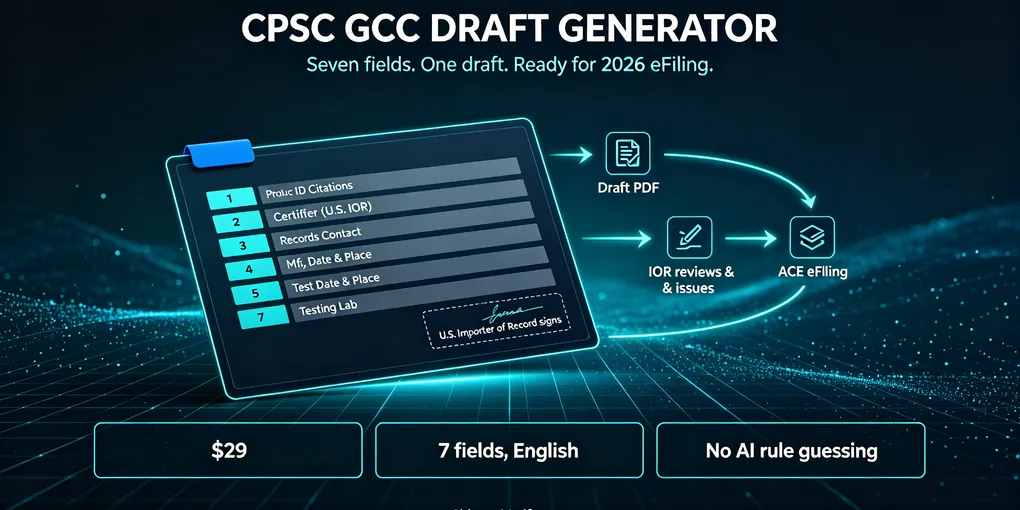
CPSC GCC Draft Generator Review: Does ChineseVerify Actually Save You Compliance Time in 2026?
1. CPSC eFiling 2026: Why Your GCC Data Now Goes Through ACE
Your container clears customs next week. Your broker just asked, for the first time, for certificate data as a PGA Message Set in ACE. Not the PDF you keep on file. The data.
That is the 2026 eFiling rule. Since July 8, 2026, importers of most CPSC-regulated consumer products have to file certificate data electronically with CBP before goods land. Goods without data sit at the port. The old “keep the certificate in the cabinet, show it if asked” routine is gone.
The document behind that data, for adult products, is a General Certificate of Conformity (GCC). It is not a certificate issued by a lab. It is a self-declaration under 16 CFR Part 1110, signed by the U.S. importer. It has seven required fields. One wrong field can hold your shipment at the worst possible moment.
So the practical question: does a $29 GCC draft tool like ChineseVerify’s actually save you time, or is it just a nicer Word template?
2. What a General Certificate of Conformity (GCC) Actually Is
Short version: a written statement from the U.S. importer or domestic manufacturer that a general-use (non-children’s) product complies with the CPSC safety rules that apply to it.
Legal basis is section 14(a) of the CPSA, as codified in 16 CFR Part 1110. If your product is a general-use consumer product subject to a CPSC rule, ban, or standard, you certify. There is no small-shipment exemption.
Who signs it: the U.S. importer of record or the U.S. manufacturer. A foreign factory cannot be the certifier. 16 CFR 1110.7 is specific about this. For imports, only the importer certifies.
The seven required fields, straight from CPSC’s GCC guidance:
- Identification of the product, specific enough to match this certificate to this product and nothing else
- Citation to each applicable CPSC product safety rule
- Name, full mailing address, and phone of the certifying importer or manufacturer
- Contact information for the person who keeps the test records
- Date of manufacture (month and year at minimum) and place of manufacture
- Date(s) and place(s) of testing
- Name and address of any third-party lab, or “N/A” if none was used
GCC vs CPC, in one table
| GCC | CPC | |
|---|---|---|
| Applies to | General-use (non-children’s) products | Children’s products (age 12 and under) |
| Issuer | U.S. importer or domestic manufacturer | U.S. importer or domestic manufacturer |
| CPSC-accepted third-party lab | Not required | Required |
| Legal basis | CPSA §14(a), 16 CFR Part 1110 | CPSA §14(a), 16 CFR Part 1109 |
| Typical products | Adult apparel, furniture, mattresses, adult bicycles | Toys, children’s apparel, cribs |
If the product is marketed for children 12 and under, or likely to be used by them, stop reading the GCC path. That is a CPC product, with its own third-party testing and certification requirements.
3. CPSC eFiling 2026: What Changed on July 8
eFiling did not change the testing rules. It changed when and how you hand over the certificate data.
Before: keep the certificate with your records, produce it if asked. After: file the data through the ACE system as a PGA Message Set before clearance. Goods entering through foreign trade zones get until January 8, 2027 (see CPSC’s eFiling page for the transition schedule).
In practice this means the seven fields on your GCC draft now have to match three places at once: the certificate you hold, the data your broker files in ACE, and the test report behind it. Mismatch one and you get a hold, or a request for explanation, at the worst possible time.
CPSC’s guidance page states the July 8 date and points importers to eFiling – CPSC’s Modern Approach for Filing Certificate Data. The rule itself lives at 16 CFR Part 1110. Note that CPSC’s own GCC page carries a caveat that its guidance may not yet reflect the new eFiling requirement, so use the dedicated eFiling page as the current source on filing dates and formats.
4. ChineseVerify GCC Draft Generator Review: What It Does
A $29 form that produces a draft GCC PDF for your IOR to review and sign. That is the whole product, and it is deliberately narrow.
The form has six parts:
- A. Importer / IOR info — name, contact, U.S. street address, the U.S. entity holding the EIN and customs bond
- B. Product identification — name, material, model, SKU, GTIN, production date, place of manufacture, intended age group
- C. Product category → suggested 16 CFR rules
- D. Manufacturer / production entity — recommended for traceability; all fields optional
- E. Test report reference — manual entry of report number, dates, lab name and address, standards
- F. Declarations — five confirmations before generation
Two details from the tool are worth reading carefully. First, the draft states it covers only the variant you entered, not other colors, sizes, or models of the same line. Multiple colors and sizes of the same model may share one GCC if materials and factory are unchanged, but you must list every covered SKU explicitly. Second, the tool says test information is for recordkeeping consistency only and does not constitute certification, accreditation, or CPSC/CBP approval.
Output is an English draft GCC PDF in one of three layouts (a classic blue dossier, a dark slate style, or a formal certificate look). Nothing is filed anywhere. Nobody signs on your behalf. The tool says so in plain terms: it does not act as IOR, does not sign, does not submit eFiling, and does not give legal advice.
One detail matters for trust. The applicable rules are not dynamically generated by AI. The tool pulls them from a fixed dataset aligned with CPSC’s official “Rules Requiring a GCC” list, and flags non-mandatory industry references (like ASTM trampoline standards) so they cannot be mistaken for legal requirements. It also states plainly that rule mapping is a drafting aid: the final applicable rules are determined by product design, materials, intended age and marketing, test records, and the IOR’s responsibility. It does not guess or improvise regulations for you.
For a feature-by-feature look at how the rule matching, the built-in lab picker, and the three certificate templates actually work — with live samples — see our GCC generator feature walkthrough.
5. GCC Draft Walkthrough: Five Steps to a Draft
Step 1 — Pick the product category. Adult apparel, furniture, mattresses, battery-containing electronics, and similar. The form shows suggested 16 CFR rules for the category. You review them; the final list is yours.
Step 2 — Review the rules. A mattress suggests 16 CFR 1632 and 1633. An adult textile product points to 16 CFR 1610. Battery-containing products surface UL 4200A references. Everything is editable, because the tool cannot know your exact design and materials.
Step 3 — Enter IOR details. This is where people mess up. Enter the U.S. importer of record: a U.S. entity with an EIN and a customs bond. Not the Chinese factory. Not the tool. The Chinese factory belongs in Section D, as the manufacturer. If you are a Chinese exporter preparing documents for a U.S. client, the client’s U.S. entity is the IOR, not you. In over 99% of cases the IOR is also the issuer named on the GCC. The tool lets you uncheck that only if a different U.S. subsidiary or internal division of the same corporate group must be named. Third-party agents cannot be listed as issuer, because the named issuer takes legal responsibility for the certificate.
Step 4 — Enter test references. Manual entry of the real test report number, dates, lab name and address. If you tested in-house under a reasonable testing program, the lab field stays N/A. If you are listing a third-party lab, confirm it is CPSC-accepted in our lab directory first. The tool does not upload, parse, or verify test files. If the factory’s registration details look off while you are filling this in, verify the factory’s USCI number against official Chinese government records before you commit a certificate to them.
Step 5 — Generate and review. Download the PDF, check all seven fields against your records, have the authorized person at the IOR sign it, then hand the data to your broker for ACE.
6. What the $29 GCC Tool Solves — and What It Doesn’t
Good fit:
- You have real test data and want a clean, correctly structured English draft without building and maintaining your own template
- Simple, single-category products
- Your U.S. IOR finds certificate formatting a recurring chore and wants a repeatable draft
Bad fit:
- Children’s products. Those need a CPC, not this tool
- No test report, hoping the tool “buys compliance.” It will not. It is explicit about this: it does not verify test results
- Listing the Chinese supplier as the certifier. The form is built to stop that
- Complex stacked rules (battery plus textile plus furniture tip-over) where you need compliance judgment, not a form
One boundary is worth repeating, because it is where users get into trouble: the tool does not act as IOR, does not sign, and does not file. If you are a foreign exporter preparing documents for a U.S. client, the client’s U.S. entity must be the certifier. Not you. Not the tool.
The honest risk: the suggested rules are a drafting aid, not a ruling. Wrong citations on a signed GCC are your liability, not the tool’s. And a confidently wrong certificate is worse than none, because under eFiling the data is traceable to you.
7. GCC Compliance Checklist Before You Sign
- Product is non-children’s (12+) and falls under at least one CPSC-enforced rule
- Real test results, or a documented reasonable testing program, with records kept five years
- All seven fields in English, matching the ACE filing data
- Certifier is the U.S. IOR, with the real name and U.S. address
- Each batch tracked separately (GTIN/SKU plus production month and year)
- A compliance person reviews the draft before the authorized signer issues it
If any item is a guess, settle it before you sign. A draft tool does not turn an unknown into a known.
8. GCC Draft Alternatives, Compared
| Word/Excel template | Lab or compliance consultant | ChineseVerify GCC Draft Generator | |
|---|---|---|---|
| Cost | Free | $300+ per product, often more | $29 per draft |
| Speed | Fast, easy to miss fields | Slow | Fast |
| Rule judgment | On you | Yes | Partial (suggested, you confirm) |
| Legal responsibility | IOR | IOR | IOR |
The decision logic is short. If you have the test data and need a clean, field-complete English draft to review and sign, the tool saves you an afternoon. If you need someone to tell you which rules apply and whether your testing plan is defensible, that is a consultant’s job, and no $29 tool should pretend otherwise.
9. The Bottom Line: GCC Draft Tools vs Compliance Consultants
A GCC draft tool is a typesetter, not a compliance outsourcer. ChineseVerify’s generator does one thing well: it produces a structurally correct draft from your data without inventing rule numbers. It does not decide your regulatory status, sign the certificate, or file it with CBP. It says so on every page of the form.
Under 2026 eFiling, the fields you file in ACE have to match your test report and your own records. Consistency beats a pretty PDF. A $29 draft that gets the seven fields right and makes the IOR actually read them is a better use of time than a template that hides the problem until a hold appears.
Disclosure: this article is for informational purposes only and does not constitute legal or compliance advice. GCC requirements are determined by CPSC regulations; consult a qualified compliance professional for product-specific guidance.
Try it: ChineseVerify GCC Draft Generator. If you are not sure whether your product is GCC or CPC, settle that with your importer or compliance contact before you file anything.
10. GCC Draft FAQ
Q: Does a GCC require a CPSC-accepted lab?
A: No. Third-party testing is not required for general-use products, and field 7 can state “N/A.” What is required is that the testing behind the certificate actually exists, through real third-party tests or a documented reasonable testing program. If you do use a lab, check it is CPSC-accepted.
Q: Can a Chinese factory sign the GCC?
A: No. For imports, only the U.S. importer of record certifies under 16 CFR 1110.7. The foreign manufacturer is named on the certificate as the place of manufacture, not as the certifier.
Q: After July 8, 2026, do I still need a paper GCC?
A: Yes. The certificate still accompanies the product and stays in your records. The eFiling rule adds the ACE data filing; it does not remove the certificate itself.
Q: Can the draft PDF be filed directly with customs?
A: No. The draft is for IOR review and issuance. The certifying U.S. entity signs it, then the certificate data is filed electronically through ACE/PGA by the importer or broker.
Q: How long should GCC records be kept?
A: At least five years. Keep the GCC itself and all supporting test reports or reasonable testing program documentation for five years from the date the certificate is created.