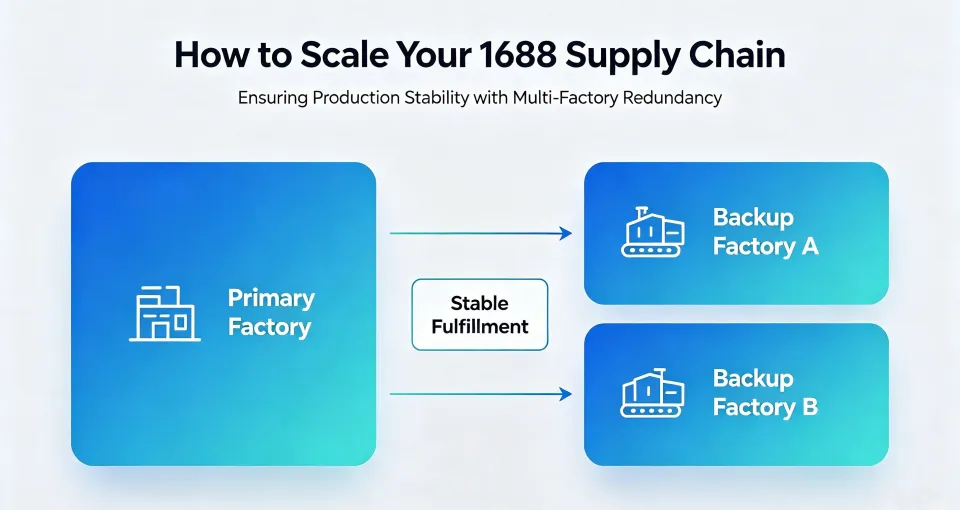
How to Scale Your 1688 Supply Chain: Ensuring Production Stability with Multi-Factory Redundancy
Introduction
Your business is growing. Orders are increasing. What was once a comfortable relationship with a single 1688 supplier now feels fragile — what happens if they cannot keep up? What if production halts during peak season? What if quality slips under pressure?
This is the supply chain scaling dilemma that every successful overseas buyer eventually faces. A single factory may be perfectly adequate for monthly orders of 500 units, but when demand jumps to 5,000 or 50,000 units, the math changes. Production lines have finite capacity. Raw material procurement has lead times. Labor is not infinite. And if that one factory fails — for any reason — your business stops.
Supply chain resilience is built on verified redundancy. This means having more than one qualified factory for every critical product category, each vetted through official enterprise data, each ready to absorb production overflow or step in during emergencies. This guide shows you how to build that system using ChineseVerify as your verification backbone.
Why Single-Supplier Dependency Is a Scaling Risk
Before building redundancy, understand what you are protecting against:
| Risk | Impact | How Often It Happens |
|---|---|---|
| Production capacity ceiling | Supplier cannot increase output beyond current maximum — your growth hits a wall | Common with small/medium factories |
| Seasonal demand spikes | During Chinese holidays (Spring Festival, National Day), production stops entirely for 1–3 weeks | Annual — predictable but disruptive |
| Raw material shortages | Supplier cannot source materials, halting your production line | Periodic, especially for specialized materials |
| Quality degradation under pressure | Rushed production leads to defects, returns, and reputation damage | Common when demand exceeds comfortable capacity |
| Regulatory shutdowns | Environmental or safety inspections force temporary closures | Increasingly frequent as China tightens enforcement |
| Supplier business failure | The supplier goes out of business, is revoked, or faces legal trouble | More common with undercapitalized factories |
A diversified supplier base is not a luxury — it is insurance against every item on this list.
Phase 1: Audit Your Existing Supplier’s True Capacity
Before you can plan for redundancy, you need an honest picture of your current supplier’s actual production capability. Most suppliers overstate their capacity. ChineseVerify gives you the data to see through the claims.
What to Verify on Your Current Supplier
1. Paid-in Capital — The Capacity Ceiling Indicator
A factory’s paid-in capital correlates strongly with its maximum sustainable output. Use this as a rough capacity gauge:
| Paid-in Capital (RMB) | Estimated Monthly Capacity Range | Suitable For |
|---|---|---|
| < 1M ($140K) | Small workshop level | Orders under $5K/month |
| 1M – 5M ($140K – $700K) | Small factory | Orders $5K – $30K/month |
| 5M – 20M ($700K – $2.8M) | Mid-sized factory | Orders $30K – $150K/month |
| 20M+ ($2.8M+) | Large manufacturer | Orders $150K+/month |
Critical insight: If your monthly order value is approaching or exceeding 20% of the supplier’s paid-in capital, the supplier is likely operating near or beyond their financial capacity. This is the trigger point for finding backup factories.
2. Business Scope — Confirm Manufacturing Capability
Re-check the business scope. As you scale, the scope becomes even more important: you need to confirm that the supplier is legally registered to manufacture at scale, not just trade or process small batches.
- Look for “生产” (production/manufacturing) listed prominently
- If the scope says “制造” (manufacturing) in addition to “生产,” this indicates a higher-tier operation
- Check for any output quantity restrictions — some scopes specify annual production limits
3. Business Status — Ongoing Stability Check
For existing suppliers, periodically verify that the business status remains “Active” (存续). A status change to “Revoked,” “Deregistered,” or “Abnormal Operations” can happen without the supplier notifying you. Set a calendar reminder to check every 3–6 months.
4. Risk Records — Early Warning System
Order a full ChineseVerify report on your existing supplier and pay special attention to:
- New litigation: Has the supplier been sued since you started working with them? Multiple new cases suggest deteriorating business practices.
- New administrative penalties: Environmental or safety fines may indicate upcoming production disruptions.
- Equity freezes: If the owner’s shares are frozen, the company is under financial stress — a precursor to potential failure.
- Capital decreases: If the supplier has lowered their registered or paid-in capital, they are contracting, not expanding.
5. Registration Change History — Signs of Instability
Check the supplier’s historical registration changes on ChineseVerify:
- Recent address changes → Are they moving to smaller facilities?
- Legal representative changes → Has ownership or control changed? The new management may be less reliable.
- Capital decreases → The company is shrinking, not growing.
The Capacity Audit Scorecard
| Checkpoint | Green Flag | Yellow Flag | Red Flag |
|---|---|---|---|
| Paid-in capital vs. your order size | Your orders < 10% of capital | Your orders 10–20% of capital | Your orders > 20% of capital |
| Business scope | “生产” listed prominently | “生产” present but secondary | No manufacturing listed |
| Business status | Active / 存续 | — | Any change from Active |
| New risk records (since last check) | None | Minor administrative penalty | Any litigation, dishonest execution |
| Registration changes | Stable (no changes) | Minor address change | Capital decrease or legal rep change |
Decision rules:
- All green: Your supplier is stable. Proceed to Phase 2 to build redundancy.
- One or more yellow: The supplier is under pressure. Begin Phase 2 immediately.
- Any red: The supplier is at risk. Accelerate backup factory qualification and reduce dependency.
Phase 2: Find and Verify Backup Factories
The next step is to identify 2–3 alternative factories for each critical product category. These backup factories should produce the same or highly similar products so they can step in with minimal transition friction.
Step 1: Search for Same-Category Factories on 1688
For each product category you source, search 1688 using the same product keywords that led you to your original supplier. This time, your goal is not to find the cheapest option — it is to build a qualified shortlist.
Sourcing strategy for redundancy:
- Avoid the same industrial cluster exclusively: If your current supplier is in Shenzhen, also search for factories in Dongguan, Guangzhou, or Foshan. Geographic diversification protects against regional disruptions (power outages, local regulatory crackdowns, natural disasters).
- Look for slightly larger factories: As you scale, a backup factory that is 30–50% larger than your current supplier gives you growth headroom.
- Search in Chinese for better results: Use Chinese keywords like “【产品名】 生产厂家” or “【产品名】 源头工厂” to find manufacturer listings rather than trading company listings.
Step 2: Run Full ChineseVerify Checks on Each Candidate
Before contacting any candidate, run their company name through ChineseVerify. Apply the same five-indicator verification you use for your primary supplier, plus these redundancy-specific checks:
Production Similarity Verification Check the candidate’s business scope against your current supplier’s scope. The closer the match, the smoother the transition will be if you need to shift production.
- ✅ Scopes are nearly identical → seamless substitution possible
- ⚠️ Scopes overlap 60–80% → substitution possible with minor adjustments
- ❌ Scopes barely overlap → this factory makes different products; not a viable backup
Capacity Comparison Compare the candidate’s paid-in capital to your current supplier’s:
- Candidate is larger: Good — you are upgrading your supply base for future growth.
- Candidate is similar size: Acceptable — provides equivalent redundancy.
- Candidate is significantly smaller: May not handle your order volumes. Suitable only as a tertiary backup for overflow of small-batch orders.
Risk Profile Comparison The backup should ideally have a cleaner risk profile than your primary supplier:
- If your primary supplier has minor risk flags and your backup has zero risks → prioritize shifting volume to the backup.
- If both have clean records → equivalent, maintain balanced allocation.
- If the backup has worse risk records than your primary → disqualify; keep searching.
Step 3: Create a Supplier Tier System
Organize your verified factories into a tiered system:
| Tier | Role | Number of Factories | Verification Depth |
|---|---|---|---|
| Tier 1 — Primary | Handles 60–70% of regular monthly volume | 1–2 per product category | Full ChineseVerify report, on-site audit if possible |
| Tier 2 — Active Backup | Handles 20–30% of regular volume (keeps relationship warm) | 1–2 per product category | Full ChineseVerify report |
| Tier 3 — Emergency Reserve | Qualified but dormant; activated during surges or Tier 1/2 failures | 1–2 per product category | Basic ChineseVerify verification + full report on standby |
The key insight: Tier 2 is not just a list — you must place small regular orders with them. A factory that hasn’t received an order from you in 12 months is not a backup; it is a stranger. Keep the relationship warm with quarterly small-batch orders.
Step 4: Qualify Backup Factories with Trial Orders
Once ChineseVerify confirms a backup factory’s legitimacy, initiate a trial engagement:
- Start with a small sample order (e.g., 5–10% of your typical monthly volume).
- Evaluate quality, communication, and delivery performance against your primary supplier.
- Run a second ChineseVerify check before placing the first production-scale order — business status and risk records can change even within months.
- Gradually increase allocation to the backup as confidence builds.
Important: Never shift more than 30% of your volume to a new backup in a single month. Phased transitions protect you if the backup underperforms.
Phase 3: Emergency Activation Protocol
Having qualified backups is only half the battle. You need a clear protocol for when and how to activate them.
Triggers for Backup Activation
| Situation | Action |
|---|---|
| Primary supplier misses 2 consecutive delivery deadlines | Immediately shift 30% of next month’s volume to Tier 2 backup |
| ChineseVerify shows new risk flag on primary supplier (lawsuit, penalty, abnormal operations) | Within 48 hours, shift 50% of volume to Tier 2; activate Tier 3 qualification |
| Primary supplier announces production halt (holiday, maintenance, regulatory) | Route all urgent orders to Tier 2; non-urgent orders wait for primary to resume |
| Primary supplier raises prices by 15%+ without justification | Shift 30% to Tier 2 as negotiating leverage while verifying Tier 2 pricing |
| Primary supplier’s business status changes to “Revoked” or “Deregistered” | Immediately cease all orders with primary; activate Tier 2 to full capacity; fast-track Tier 3 to Tier 2 status |
Emergency Order Checklist
When activating a backup factory under time pressure:
- Re-verify the backup’s current ChineseVerify profile — ensure no new risks have appeared since your last check.
- Confirm current production capacity — the backup may have taken on other clients since your trial order.
- Negotiate pricing transparently — explain the situation. A factory that knows it is earning your trust for the long term will offer fair pricing.
- Place a bridge order — start with a smaller quantity than your full need to test current quality before scaling up.
- Communicate with your primary supplier — let them know you are diversifying. This alone sometimes solves capacity and pricing issues.
Real-World Scaling Example
From 500 to 50,000 Units: How One Buyer Built a Resilient Supply Chain
An Australian home goods brand had been sourcing bamboo kitchenware from a single 1688 factory in Zhejiang for two years. Monthly orders averaged 1,000 units at approximately $8,000/month — comfortable for their supplier’s scale (paid-in capital: 3M RMB).
Then a major Australian retailer placed a stocking order: 50,000 units to be delivered within 90 days across 12 product SKUs. The monthly volume would jump from $8,000 to $140,000 over three months.
ChineseVerify Capacity Audit Findings:
- Primary supplier paid-in capital: 3M RMB (~$420K). The new monthly volume ($47K/month) was approximately 11% of capital — in the yellow zone.
- Business scope confirmed manufacturing but listed no automated production — the factory was primarily manual assembly, limiting throughput.
- Risk records were clean, but the supplier had a recent registered address change to a smaller facility — a capacity contraction signal.
Redundancy Plan Executed:
- The buyer searched 1688 for the same bamboo kitchenware categories and identified 4 additional factories in Zhejiang, Fujian, and Guangdong (geographic diversification).
- ChineseVerify checks on all 4 candidates yielded:
- Factory B: Paid-in capital 8M RMB, identical business scope, zero risk records → designated as Tier 2 primary backup.
- Factory C: Paid-in capital 5M RMB, scope overlap 85%, one minor administrative fine for labeling → designated as Tier 2 secondary.
- Factory D: Paid-in capital 1M RMB, scope mostly trading → disqualified.
- Factory E: Paid-in capital 12M RMB, automated production listed in scope, zero risks → designated as Tier 1 co-primary for the new volume.
- Trial orders of 200 units each were placed with Factory B and Factory E. Both delivered on time with equal quality.
- The 50,000-unit order was split: 40% to original supplier, 35% to Factory E, 25% to Factory B.
- All three factories delivered on schedule. The buyer now maintains a permanent three-factory system.
Result: The buyer met the retailer’s deadline, avoided single-supplier dependency, and built a supply chain that scales to 50,000+ units without breaking. The investment in ChineseVerify checks and trial orders was under $500 — against a $420,000 contract.
Best Practices for Supply Chain Redundancy
1. Start building redundancy before you need it The worst time to find a backup factory is when your primary supplier has just failed. Start the Phase 2 process when your order volume reaches 50% of your supplier’s estimated capacity, not 90%.
2. Re-verify all suppliers quarterly Set a recurring calendar event. Run ChineseVerify checks on your entire Tier 1 and Tier 2 supplier list every 3 months. A supplier’s status can change without notice.
3. Diversify geographically Do not put all your factories in the same industrial zone, city, or even province. Regional disruptions — from power rationing to COVID-style lockdowns — can affect an entire area simultaneously.
4. Keep Tier 2 relationships warm with regular orders A backup that never receives orders is not a backup. Allocate at least 10–15% of your monthly volume to Tier 2 suppliers. This keeps them invested in your quality standards and responsive to your needs.
5. Document everything Maintain a supplier dossier for each factory: ChineseVerify reports (dated), trial order evaluations, quality metrics, delivery performance, and communication history. If a dispute arises, this documentation is your strongest defense.
6. Use paid-in capital trends as an early warning A factory that is growing will show increasing paid-in capital over time. A factory in decline will show decreasing or static capital. Track this trend across quarterly ChineseVerify checks — it is a leading indicator of future reliability.
Conclusion
Growing demand should be a problem you are happy to have — not a crisis that keeps you awake at night. The difference between the two is supply chain redundancy.
By using ChineseVerify (https://www.chineseverify.com) to verify your existing supplier’s true capacity, identify and qualify backup factories, and continuously monitor all suppliers’ enterprise health, you transform supply chain management from reactive firefighting to proactive engineering. You know exactly how much each factory can produce. You know which backup is ready to activate. You know the warning signs to watch for — and you check for them regularly.
The $19 you spend on a ChineseVerify report for a backup factory is not a cost. It is the premium on an insurance policy that protects your revenue, your reputation, and your ability to say “yes” to the next big order with confidence.
Verify your supply chain partners now →
FAQs About 1688 Supply Chain Scaling
1. How many backup factories do I really need per product category?
A minimum of one active backup (Tier 2) and one emergency reserve (Tier 3) per critical product category. For products that represent more than 30% of your total revenue, add a second Tier 2 backup. The cost of maintaining these relationships through small regular orders is negligible compared to the cost of a supply disruption.
2. Will my primary supplier be offended if I work with other factories?
Most professional Chinese manufacturers understand that overseas buyers diversify their supply chains. Be transparent: explain that as your business grows, you need multiple production lines to meet demand. A supplier that reacts negatively to this conversation may be one that planned to exploit your dependency. A supplier that welcomes it understands long-term partnership thinking.
3. How do I know when to switch from backup to primary?
Switch when the backup consistently outperforms the primary across three key metrics: quality (defect rate), delivery reliability (on-time percentage), and communication responsiveness. Run ChineseVerify checks on both before making the switch — verify that the backup’s risk profile remains clean while the primary’s shows deterioration.
4. What if the backup factory’s product quality is different from my primary?
Some variation between factories is normal, especially for handcrafted or assembled products. The key is whether the backup can match your minimum acceptable quality standard — not whether it perfectly replicates your primary’s output. Use trial orders to establish clear quality specifications (samples, photos, written standards) that any qualified factory can follow.
5. Can I use ChineseVerify to find entirely new suppliers in product categories I haven’t sourced before?
Yes. The verification methodology is the same: search 1688 for the product category, run ChineseVerify checks on the candidates, pay special attention to business scope (does it include the new product type?), and start with trial orders. For an entirely new category, build your supplier base using the same tiered system from the beginning — do not wait until you are dependent on a single factory.
More reading
- How to Identify a Real Factory vs. Trading Company on 1688
- How to Verify 1688 Suppliers: A Complete Guide for Overseas Buyers
- Chinese Supplier Risk Assessment: Practical Due Diligence for Global Buyers
Published by the ChineseVerify Team