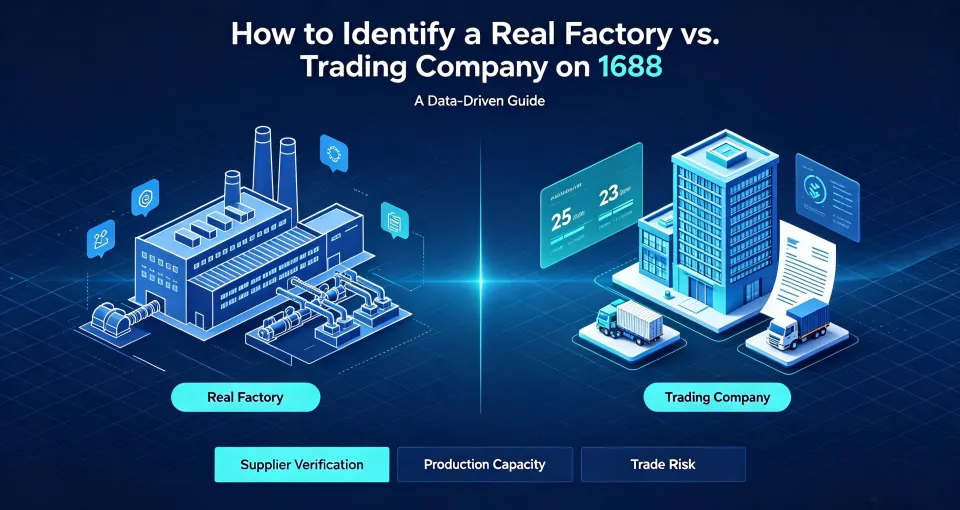
How to Identify a Real Factory vs. Trading Company on 1688: A Data-Driven Guide
Introduction
For overseas buyers sourcing from 1688, the single most important question is: is this supplier a real factory or just a trading company?
The answer determines everything — your pricing, your product quality, your production lead times, and your supply chain stability. A genuine factory gives you direct access to manufacturing, the ability to customize products, and transparent cost structures. A trading company adds a markup, has no control over production, and may not even know who the real manufacturer is.
Yet on 1688, virtually every supplier claims to be a factory. Store names include terms like “厂家直销” (factory direct), “源头工厂” (source factory), and “生产厂家” (manufacturer). Many trading companies invest heavily in factory-style storefronts with staged photos of production lines that they do not own.
The good news is that Chinese government registration data does not lie. By checking a supplier’s official enterprise records, you can see through the marketing and make data-driven decisions. This guide shows you exactly which data points to check and how to interpret them.
The Five Key Indicators of Factory Strength
When you look up a 1688 supplier on ChineseVerify, focus on these five data dimensions. Together, they paint an accurate picture of whether you are dealing with a real manufacturer.
1. Business Scope (经营范围) — The Identity Card
The business scope is the single most revealing field in any Chinese company registration. It is an officially approved list of all business activities the company is legally permitted to engage in.
Green flags (likely a factory):
- The business scope includes the word “生产” (production/manufacturing)
- Specific manufacturing activities are listed (e.g., “生产电子产品” — manufacture of electronic products)
- The scope mentions “加工” (processing) — a key indicator of manufacturing capability
- The company’s own brand or product category appears in the scope
Red flags (likely a trading company):
- The scope only says “销售” (sales), “批发” (wholesale), or “零售” (retail)
- The scope says “贸易” (trading) without any manufacturing activity
- The company is described as a “商贸有限公司” (trading company limited) in its legal name
- No manufacturing or processing activities are listed at all
How to check on ChineseVerify: On the company profile page, look for the “Business Scope” field. Read it carefully — Chinese business scopes list activities in a specific order, with core activities first. If “生产” does not appear, or appears far down the list after sales/trading activities, the company is primarily a trader.
2. Registered Capital & Paid-in Capital (注册资本 & 实缴资本) — The Financial Reality
A company’s capital structure reveals its true financial scale. Crucially, there are two numbers you must compare:
| Capital Type | What It Means |
|---|---|
| Registered Capital (注册资本) | The amount the company declares it has invested. Since 2014, Chinese companies are not required to actually pay this amount immediately — it can be a future promise. |
| Paid-in Capital (实缴资本) | The amount shareholders have actually contributed in cash or assets. This is the real number. |
How to interpret the gap:
| Scenario | Verdict |
|---|---|
| Registered: 10M RMB, Paid-in: 10M RMB | ✅ Strong. The company has fully funded its declared capital. |
| Registered: 10M RMB, Paid-in: 1M RMB | ⚠️ Moderate. The company has partially funded. Acceptable for a growing business. |
| Registered: 50M RMB, Paid-in: 0 RMB | ❌ Red flag. The company claims massive scale but has contributed nothing. Treat registered capital claims as marketing. |
| Registered: 100K RMB, Paid-in: 100K RMB | ⚠️ Small scale. A legitimate small factory, but limited production capacity. Match your order size accordingly. |
Rule of thumb: For a factory claiming significant production capacity, the paid-in capital should be at least several million RMB. A “factory” with only 100K RMB (approximately $14,000) in paid-in capital cannot realistically operate a meaningful production line.
3. Business Status (经营状态) — The Survival Check
A supplier’s current business status tells you whether they are legally operational:
| Status | Meaning | Action |
|---|---|---|
| 存续 (Active) | Normal operating status | ✅ Proceed with verification |
| 在业 (In Business) | Active (alternate term used in some regions) | ✅ Proceed with verification |
| 吊销 (Revoked) | Business license revoked by authorities | ❌ Do not engage — the company has been penalized |
| 注销 (Deregistered) | Company has been legally dissolved | ❌ The company no longer exists |
| 迁出 (Relocated) | The company has moved to a different registration jurisdiction | ⚠️ Verify the new registration details |
| 停业 (Suspended) | Operations suspended | ❌ Factory is not producing |
How to check on ChineseVerify: The business status is displayed prominently on the free basic profile. This is your quickest first-pass filter — if the status is anything other than “Active,” stop right there.
4. Risk Records (风险信息) — The Hidden Danger Zone
Even a supplier that passes the business scope and capital checks may be hiding serious problems. The risk section of a ChineseVerify report reveals the truth:
Litigation Records (诉讼记录)
- Defendant in product quality lawsuits → The supplier has a history of delivering substandard goods. Other buyers have already had problems.
- Defendant in contract disputes → The supplier breaches agreements. Your contract is at risk.
- Frequent plaintiff cases (they sue others) → May indicate aggressive legal behavior, but less concerning than being sued.
- Zero litigation → Clean record. This is what you want to see.
Administrative Penalties (行政处罚)
- Environmental fines → The factory may face production shutdowns. Also a compliance risk for your own supply chain.
- Safety violation penalties → Poor working conditions that could disrupt production.
- Tax penalties → Financial management issues. May indicate broader operational problems.
- Product quality fines → The supplier has been penalized for quality violations by Chinese regulators.
Dishonest Execution Records (失信被执行人) This is the nuclear option of red flags. A company on this list has defied a Chinese court order to pay debts or fulfill obligations. The consequences are severe — travel restrictions, credit freezes, and business bans. A factory on this list cannot be trusted with your money.
Abnormal Operations List (经营异常名录) The company has been flagged by SAMR (the market regulator). Common reasons include:
- Failure to submit annual reports
- Cannot be contacted at the registered address
- Providing false registration information
A company on this list is under active regulatory scrutiny. Do not place orders.
How to check on ChineseVerify: Order a full verification report to access the complete risk section. The free profile only shows basic registration data.
5. Establishment Date & Registration History (成立日期 & 变更记录) — The Track Record
A factory’s history reveals its stability and experience:
Establishment Date
- 10+ years: Long track record. Surviving over a decade in China’s competitive manufacturing environment suggests a stable, legitimate business.
- 5–10 years: Established and experienced. Reasonable for a mid-sized factory.
- 2–5 years: Relatively new but may be legitimate. Verify other indicators more carefully.
- Less than 1 year: Very new. Treat as high risk regardless of other factors. Start with small trial orders.
Registration Changes (工商变更) Frequent changes to key registration items can signal instability:
- Frequent address changes → The factory may be relocating to avoid creditors or regulatory issues.
- Frequent legal representative changes → Ownership instability. Who is really in charge?
- Frequent business scope changes → The company keeps pivoting. What do they actually do?
- Capital decreases → The company is reducing its declared scale — a sign of contraction.
Putting It All Together: The Factory Strength Scorecard
Use this scorecard to evaluate any 1688 supplier:
| Indicator | Green (+2 pts) | Yellow (0 pts) | Red (−2 pts) |
|---|---|---|---|
| Business Scope | “生产” or “加工” listed first | “生产” listed after sales activities | No manufacturing at all |
| Paid-in Capital | ≥ 5M RMB fully paid | 1–5M RMB partially paid | 0 or < 1M RMB |
| Business Status | Active (存续/在业) | Relocated (迁出) | Revoked, Deregistered, Suspended |
| Risk Records | Zero litigation, zero penalties | Minor administrative penalty only | Any litigation as defendant, dishonest execution, or abnormal operations |
| Establishment Date | 5+ years | 2–5 years | < 2 years |
Score interpretation:
- 8–10 points: Strong factory profile. Proceed with confidence.
- 4–7 points: Moderate. Verify further or start with a small trial order.
- 0–3 points: Weak. Treat as a trading company; do not pay large deposits.
- Negative score: Do not engage under any circumstances.
Real-World Identification Examples
Example 1: The “Smart Factory” That Was Just a Sales Office
Supplier claim on 1688: “20 years of smart home device manufacturing, 10,000 sqm factory, R&D team of 50 engineers.”
ChineseVerify revealed:
- Business scope: “智能家居产品销售、技术咨询” (Smart home product sales, technical consulting) — no manufacturing
- Paid-in capital: 0 RMB (registered: 5M RMB, all unpaid)
- Registered address: Room 1208, Office Tower B, Shenzhen CBD — clearly not a factory location
- Establishment date: 1.5 years ago
- Risk: One pending contract dispute case as defendant
Verdict: Pure trading company operating from a virtual office. Score: 0 (Red on 4 out of 5 indicators). The “factory photos” on their 1688 store were taken at someone else’s facility.
Example 2: The Modest Factory That Was Legitimate
Supplier claim on 1688: “Metal parts processing factory, established 2012.”
ChineseVerify revealed:
- Business scope: “金属制品加工、生产、销售” (Metal product processing, manufacturing, sales) — manufacturing listed first
- Paid-in capital: 8M RMB (registered: 8M RMB) — fully paid
- Business status: Active (存续)
- Registered address: Industrial Zone, Dongguan — a real manufacturing area
- Establishment date: 2012 (13+ years)
- Risk: Zero litigation, zero penalties, zero abnormal records
Verdict: Genuine manufacturer with solid financials and a clean record. Score: 10. A supplier to confidently build a relationship with.
Example 3: The Factory Hiding a Dishonest Execution Record
Supplier claim on 1688: “Large textile factory, ISO-certified, export to 20+ countries.”
ChineseVerify revealed:
- Business scope: “纺织品生产、加工” (Textile production, processing) — looks like a factory ✅
- Paid-in capital: 5M RMB — reasonable ✅
- Business status: Active ✅
- Establishment date: 2010 — 16 years ✅
- Risk: One active dishonest execution record ❌❌❌
Verdict: Despite passing most checks, this supplier has a fatal risk. The dishonest execution record means they have refused to comply with a court judgment. Score: 6 but automatic disqualification due to the dishonest execution flag. Do not engage.
This example illustrates a crucial point: a single red flag in the risk section overrides all other green indicators. Always check the risk records last — they are the final gatekeeper.
Best Practices for Factory Identification
1. Never trust the 1688 store description alone 1688 allows sellers to self-describe as “factory direct” or “manufacturer” without verification. The official registration data is the only objective source of truth.
2. Use the business scope as your primary filter “生产” and “加工” are the two magic words. If neither appears in the business scope, the supplier is not a manufacturer — regardless of what their store says.
3. Compare paid-in capital against order size As a rule of thumb, do not place an order exceeding 10–20% of a supplier’s paid-in capital. A factory with 1M RMB paid-in capital ($140K) should not be trusted with a $50K prepayment.
4. Build a shortlist, then verify systematically For any major sourcing project, identify 5–10 potential 1688 suppliers, run a ChineseVerify check on each one, and rank them using the scorecard. This turns supplier selection from guesswork into a data-driven process.
5. Re-verify every 6–12 months A factory that was clean last year may have new litigation, administrative penalties, or abnormal operations flags. Set a recurring calendar reminder for your key suppliers.
6. Verify the downstream supply chain too If you are ordering specialized or brand-name components, ask the 1688 supplier who their raw material or component suppliers are, and verify those upstream companies as well. A factory is only as reliable as its supply chain.
Conclusion
On 1688, anyone can claim to be a factory. Store names, photos, and sales conversations are all designed to convince you. But Chinese enterprise registration data — the official government record of every legally registered company in China — tells you the truth.
By checking five key indicators — business scope, paid-in capital, business status, risk records, and establishment history — you can determine within minutes whether a 1688 supplier is a genuine manufacturer with real production strength, a trading company in disguise, or something worse.
The factory strength scorecard in this guide turns subjective impressions into objective scores. A $19 ChineseVerify report eliminates the guesswork and protects your sourcing budget from costly mistakes. Whether you are placing your first 1688 order or managing a mature China supply chain, these verification steps belong in your standard operating procedure.
Start verifying your 1688 suppliers now →
FAQs About Identifying 1688 Factories
1. Can a company with “贸易” (trading) in its legal name still be a manufacturer?
Rarely. Chinese company names follow strict naming rules. “贸易有限公司” specifically indicates a trading company. However, some companies may register subsidiaries with “贸易” in the name for tax or operational reasons while having manufacturing operations under a different entity. If you see this, ask the supplier for the manufacturing entity’s company name and verify that one separately.
2. What if the business scope includes “生产” but it is listed last?
The ordering of activities in a Chinese business scope typically reflects their importance to the company’s actual operations. If “生产” appears last after a long list of sales and trading activities, manufacturing is likely a minor part of their business — if it exists at all. Prioritize suppliers where manufacturing activities are listed first or second.
3. Is a high registered capital always a good sign?
No. Since 2014, Chinese companies can set their registered capital at almost any figure without actually contributing the money. Some companies inflate their registered capital to appear larger. Always check the paid-in capital — this is the number that reflects actual financial commitment. A 100M RMB registered capital with 0 RMB paid-in is worse than a 1M RMB fully paid capital.
4. What is the most reliable single indicator of a real factory?
The presence of “生产” (production/manufacturing) in the business scope, combined with a registered address in an industrial zone (工业园区) or manufacturing area (e.g., Dongguan, Shenzhen Bao’an, Suzhou industrial districts). A “factory” registered in a downtown office building is almost certainly not one.
5. How do I find the registered address on ChineseVerify?
The registered address is displayed on the free basic profile for every company. Look at the address carefully — industrial zones, development districts (开发区), and manufacturing parks (工业园) indicate factory locations. Addresses containing “Room” (室) or “Floor” (层) followed by office building names indicate office locations, not factories.
More reading
- How to Verify 1688 Suppliers: A Complete Guide for Overseas Buyers
- How to Screen Real Factories from 1688 Suppliers
- How to Check Chinese Company Business Scope
- How to Scale Your 1688 Supply Chain with Multi-Factory Redundancy
Published by the ChineseVerify Team