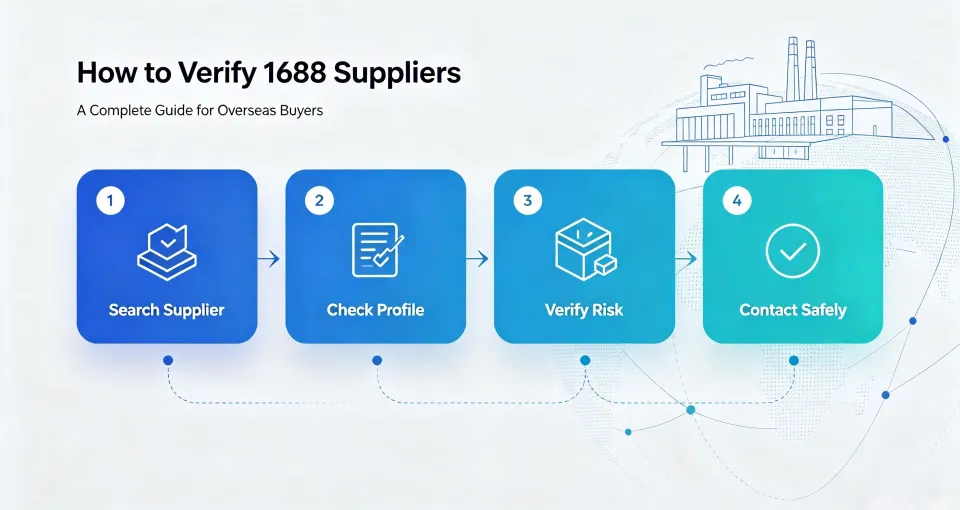
How to Verify 1688 Suppliers: A Complete Guide for Overseas Buyers
Introduction
Alibaba’s 1688.com is the largest domestic B2B wholesale platform in China, hosting millions of Chinese manufacturers, wholesalers, and trading companies. For overseas buyers and sourcing agents, 1688 offers unbeatable factory-direct prices that are often significantly lower than Alibaba International or other global platforms.
However, there is a catch: 1688 is built exclusively for the Chinese domestic market. The platform operates entirely in Chinese, requires a mainland China business license to register as a seller, and offers no built-in buyer protection for overseas purchasers. Worse, not every seller on 1688 is a genuine manufacturer — many are middlemen posing as factories, and some are outright scammers.
Before you wire a deposit or place a bulk order, verifying your 1688 supplier’s business legitimacy is non-negotiable. This tutorial walks you through exactly how to validate a 1688 supplier’s credentials using official Chinese business data — so you can source with confidence and avoid costly mistakes.
Why 1688 Supplier Verification Matters
Overseas buyers face unique risks when sourcing from 1688:
- Factory vs. Trading Company Confusion: A supplier may present themselves as a manufacturer but actually be a trading company that marks up prices and has no control over production quality.
- Fake Business Licenses: Fraudulent sellers may display altered or entirely fabricated business licenses on their store page.
- No Overseas Buyer Protection: Unlike Alibaba International with its Trade Assurance program, 1688 transactions between overseas buyers and Chinese sellers have no platform-backed dispute resolution.
- Ghost Suppliers: Some sellers collect deposits for large orders and then disappear — their company registration may already be revoked or flagged for abnormal operations.
- Quality & Compliance Risk: Unverified suppliers may lack the necessary production licenses, export qualifications, or regulatory compliance for your target market.
A quick check of the supplier’s official business records eliminates most of these risks before any money changes hands.
Step-by-Step Guide: Verify a 1688 Supplier
Step 1: Locate the Supplier’s Company Name on 1688
Every 1688 store is backed by a registered Chinese business entity. Start by finding the supplier’s legal company name:
- Open the supplier’s 1688 store page.
- Look for the company name displayed in the store header or sidebar. It typically appears in Chinese characters (e.g., “深圳市某某电子有限公司”).
- Click into the “公司档案” (Company Profile) section. This page displays the supplier’s registered business information as filed with 1688.
- Note down the exact Chinese company name and, if shown, the Unified Social Credit Code (统一社会信用代码).
Tip: The company name on 1688 should match the name on the supplier’s business license. If the supplier refuses to share their business license, treat this as a red flag.
Step 2: Verify the Company on ChineseVerify
Now that you have the company name, validate it against official Chinese government records:
- Go to https://www.chineseverify.com
- Enter the company name (Chinese or English) into the search bar.
- Review the search results and select the matching company. Use the registered address to help distinguish companies with similar names.
What you should confirm on the free basic profile:
| Check Item | What to Look For |
|---|---|
| Company Name | Must match exactly what is displayed on the 1688 store page |
| Business Status | Must be “Active” (存续). If it shows “Revoked” (吊销) or “Deregistered” (注销), do not engage |
| Establishment Date | How long has the company existed? A company registered 3 months ago claiming 10 years of experience is lying |
| Registered Capital | Does the scale match the supplier’s claims? A factory claiming massive production capacity but showing minimal registered capital is suspicious |
| Business Scope | Does the company’s official business scope include the type of products they are selling? If they sell electronics but are registered for “food wholesale,” something is wrong |
Step 3: Cross-Check Ownership and Risk Records
The free profile gives you a baseline. For high-value orders or long-term partnerships, order the full verification report to dig deeper:
Ownership & Identity Verification
- Check that the legal representative on ChineseVerify matches the person you are communicating with. If the contact claims to be the factory owner but is not the legal representative, ask why.
- Review the shareholder structure. If the shareholders are other trading companies rather than individuals with manufacturing backgrounds, the supplier is likely a middleman, not a factory.
- Confirm the registered address describes a physical location where manufacturing is plausible. A factory registered at a virtual office address in a downtown commercial building should raise questions.
Risk Records — The Dealbreaker Section
- Litigation records: Has the supplier been sued by other buyers? Multiple lawsuits for contract disputes or product quality issues are a clear warning.
- Administrative penalties: Fines for safety violations, environmental non-compliance, or product quality issues indicate operational problems.
- Dishonest execution records: The strongest red flag — the company has defied court orders. Walk away immediately.
- Abnormal operations list: The company is under regulatory scrutiny. Do not place orders until this is resolved.
Step 4: Match 1688 Claims Against Official Records
Compare what the supplier claims on their 1688 store against the official data from ChineseVerify:
| 1688 Claim | What to Validate on ChineseVerify |
|---|---|
| “We are a factory with 20 years of experience” | Establishment date: is the company even 5 years old? |
| “We have ISO 9001 certification” | Intellectual property section: check for registered quality certifications |
| “Annual revenue: 50 million RMB” | Registered capital and paid-in capital: is the financial scale credible? |
| “We own our production facility” | Registered address: is it an industrial zone or a virtual office? |
| “Direct manufacturer, no middlemen” | Business scope and shareholder structure: any indication of trading-only status? |
| Company name on 1688 | Exact match on ChineseVerify (beware of similar-sounding names) |
Step 5: Assess the Supplier’s Export Capability
Many 1688 suppliers are purely domestic operators with no export experience or qualifications:
- Check the business scope for import/export registration (进出口). Chinese companies need explicit registration to legally export goods.
- Review the Customs registration status. Companies without customs filing cannot issue export documentation.
- Look up any trademark registrations — legitimate manufacturers often register their own brands.
Pro Tip: Even if a supplier looks clean on all risk checks, if they lack export qualifications, you will face logistics complications. Factor this into your supplier evaluation.
Real-World Verification Scenarios
Scenario 1: The “Factory” That Was Actually a Trading Company
An overseas buyer found an electronics supplier on 1688 claiming to be a “direct manufacturer” with a 5,000-square-meter factory. The supplier’s store looked professional, complete with factory floor photos and quality certifications.
Verification on ChineseVerify revealed:
- Business scope: “wholesale and retail of electronic products” — no manufacturing activities
- Registered address: a small office in a commercial building
- Registered capital: 100,000 RMB (less than $14,000)
Outcome: The “factory” was a small trading company. The buyer avoided placing a $50,000 order and found a genuine manufacturer after further searching.
Scenario 2: The Supplier with Hidden Litigation
A sourcing agent in Southeast Asia was about to place a $30,000 order with a 1688 furniture supplier. The supplier’s communication was responsive, and their 1688 store had positive reviews.
Verification on ChineseVerify revealed:
- Three active litigation cases where the supplier was the defendant
- Two cases involved contract disputes with overseas buyers over substandard product quality
- One administrative penalty for fire safety violations at their production facility
Outcome: The agent discontinued negotiations immediately and avoided a near-certain loss.
Scenario 3: The “Established” Company That Was Only 8 Months Old
A European importer was impressed by a 1688 textile supplier who claimed “over 15 years of manufacturing experience” and sent high-quality product samples.
Verification on ChineseVerify revealed:
- Establishment date: 8 months ago
- Business status: Active (newly registered, not 15 years old)
- No prior annual reports filed
Outcome: The supplier was a newly registered company, not an established manufacturer. The importer adjusted their order size and payment terms to mitigate risk — starting with a small trial order paid upon delivery rather than a large deposit.
Best Practices for 1688 Supplier Verification
1. Always verify before the first payment Never wire a deposit without first checking the supplier’s official business records. A $19 ChineseVerify report can prevent losses that range from hundreds to hundreds of thousands of dollars.
2. Verify every supplier — even “recommended” ones Do not rely on 1688 store ratings, reviews, or agent recommendations alone. Store ratings can be manipulated, and reviews can be fabricated. Only official government data is reliable.
3. Watch for name discrepancies If the company name on 1688 does not match the name on ChineseVerify — even by one character — investigate further. Some fraudulent sellers register company names that are almost identical to legitimate manufacturers to deceive buyers.
4. Verify periodically for ongoing relationships Re-verify your key 1688 suppliers every 6 months. Business status, risk records, and ownership can change. A supplier that was clean last year may have accumulated serious issues.
5. Combine verification with factory audits ChineseVerify validates the legal and financial background of a supplier. Combine this with an on-site factory audit (or third-party inspection) for a complete due diligence process — especially for large or long-term orders.
6. Keep verification records Download and archive each verification report. If a dispute arises, having a dated record of your due diligence supports your position and demonstrates that you acted in good faith.
Conclusion
Sourcing from 1688 can unlock significant cost advantages for overseas buyers — but only if you do your homework first. The platform’s domestic-China focus means that buyer protection, transparency, and English-language support are minimal. The responsibility for supplier verification falls entirely on you.
ChineseVerify (https://www.chineseverify.com) bridges this gap by giving you instant, English-language access to authoritative Chinese government data on any 1688 supplier. In five minutes, you can move from “this supplier looks good” to “I have confirmed this supplier is a legally registered, active business with no major risk flags.”
Before your next 1688 order, invest 5 minutes and $19 in supplier verification. It is the cheapest insurance policy your sourcing operation will ever have.
Verify your 1688 supplier now →
FAQs About 1688 Supplier Verification
1. Can I verify a 1688 supplier without knowing Chinese?
Yes. ChineseVerify provides a fully English-language interface and professional English reports. Simply copy the Chinese company name from the 1688 store page and paste it into the ChineseVerify search bar. The system handles the rest and presents results in English.
2. What if the supplier’s company name on 1688 does not match any ChineseVerify results?
This is a major red flag. Possible explanations: (a) the company name displayed on 1688 is a trading name, not the legal entity name — ask for the business license to find the legal name; (b) the company has been deregistered; or (c) the listing is fraudulent. Do not proceed until you resolve this discrepancy.
3. Is every 1688 supplier a genuine manufacturer?
No. 1688 hosts manufacturers, trading companies, wholesalers, and authorized distributors. Many sellers present themselves as “factories” or “direct manufacturers” even when they are not. Checking the business scope and registered address on ChineseVerify is the most reliable way to tell them apart.
4. How long does supplier verification take?
A basic ChineseVerify search and free profile review takes under one minute. A full verification report is delivered within minutes of ordering. The entire verification process — from searching the company name to reviewing the complete risk profile — typically takes less than five minutes.
5. Does ChineseVerify cover all 1688 sellers?
ChineseVerify covers all legally registered mainland Chinese companies. Since 1688 requires sellers to have a valid Chinese business license, nearly all legitimate 1688 stores are backed by a company that can be found on ChineseVerify. Sellers operating without valid registration are a red flag in themselves.
More reading
- How to Identify a Real Factory vs. Trading Company on 1688
- How to Screen Real Factories from 1688 Suppliers
- 1688.com Supplier Verification: What Platform Badges Hide and Government Records Reveal
- Alibaba International vs. 1688: Stop Confusing the Two Platforms
Published by the ChineseVerify Team