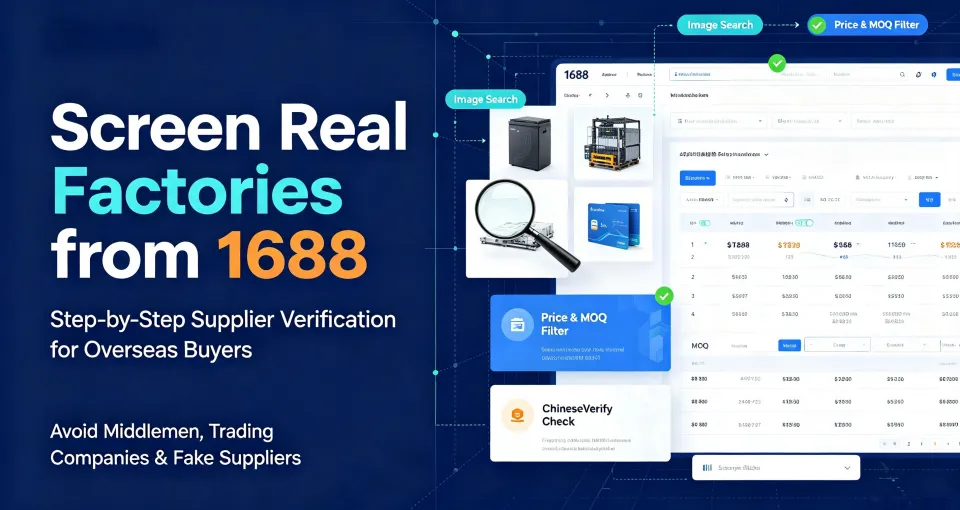
How to Screen Real Factories from 1688 Suppliers: A Step-by-Step Verification Guide
1. The Problem: Everyone on 1688 Says They Are a Factory
If you have spent any time sourcing on 1688, you have seen this pattern.
You search for a product — say, silicone kitchen utensils. You get 200 results. The product photos look identical across dozens of stores. The prices are in the same range. The store names all say “factory direct” or “source manufacturer.” How do you know which one actually makes the product?
The honest answer: most of them do not.
1688 is Alibaba’s domestic Chinese wholesale platform. It was built for the Chinese market, where trading companies, wholesalers, and resellers are just as common as manufacturers. The platform does not strictly verify whether a store with a “Factory Store” badge is actually a factory. Store names, badges, and self-declared qualifications can be misleading — and often are.
For overseas buyers, the consequences of picking the wrong supplier are real: higher prices from middleman markups, no control over production quality, inability to customize products, and in the worst case, deposits paid to a company that never delivers.
This guide gives you a 3-step repeatable process to filter out middlemen and identify genuine factories on 1688. It combines a sourcing tactic (reverse image search), a pricing filter (MOQ comparison), and official Chinese government verification (ChineseVerify.com). No guesswork. No reliance on store ratings. Just a system that works.
2. Why Most “Factories” on 1688 Are Not Factories
Before the how-to, understand the landscape.
1688’s seller registration system allows trading companies and resellers to open stores and label themselves as factories. There is no mandatory on-site inspection. The “Factory Store” badge requires some documentation, but it can be obtained through third-party agents — and it does not verify that the company actually manufactures anything.
Here is what typically happens behind the scenes: one real factory supplies 20 or 30 different 1688 stores. Each store lists the same products with the same photos. Each store claims to be the manufacturer. Each store adds a markup. When an overseas buyer places an order, the store simply forwards it to the real factory — and takes a cut.
The telltale sign: multiple stores selling the exact same product at the exact same price with the exact same minimum order quantity. This pattern is not a coincidence. It is the footprint of a middleman network all sourcing from the same upstream supplier.
Working with a middleman means:
- You pay more than you need to.
- You cannot negotiate directly with the factory on specs or customizations.
- You have no visibility into actual production capacity.
- If the middleman disappears, you have no relationship with the real manufacturer.
3. The 3-Step Verification Workflow
Here is the system. It takes less than 30 minutes per supplier and requires no special tools or relationships.
Core logic:
- Download product images → reverse image search to find all sellers of the same product
- Compare prices and MOQs to identify reseller networks
- Verify the remaining candidates’ legal registration via ChineseVerify.com
Step 1: Download Product Images
On 1688, find the product you want to source. Download two or three clear product images — the main product shot, not close-ups or lifestyle photos with heavy watermarks. Clean, front-facing product images work best for the next step.
The goal is to use these images to trace the product back to its original source.
Step 2: Reverse Image Search on 1688
1688 has a built-in image search function (look for the camera icon in the search bar). Upload the product images you downloaded.
The results will show every 1688 listing that uses the same or similar product images. Collect all matching stores — not just the first few, but as many as you can find. Look for stores that display:
- Identical product photos
- Same packaging
- Same background or shooting scene
These stores are all selling the same product. One of them might be the original factory. Most are not.
Step 3: Price & MOQ Filter — The Middleman Detector
This is the most effective filter in the entire process.
For each store you collected in Step 2, record the unit price and minimum order quantity (MOQ) for the same product.
Now look at the pattern.
If 5, 10, or 15 different stores all list the exact same price and the exact same MOQ for identical products — those stores are almost certainly part of a reseller network. They are not independent factories. They are all sourcing from a single upstream supplier and reselling at a uniform markup.
Real factories set their own prices and their own MOQs. They have different cost structures, different production capacities, and different pricing strategies. Two genuine factories may produce the same type of product, but their prices and MOQs will differ — sometimes by a little, sometimes by a lot.
The rule: same product + same price + same MOQ across multiple stores = resellers. Eliminate them.
Exception: if one or two stores have a noticeably lower price or a more flexible MOQ than all the others, those are your priority candidates. They may be the original manufacturer.
After this filter, you should be left with a small number of candidate stores — typically 2 to 5, not 50.
Step 4: Verify the Remaining Candidates on ChineseVerify.com
Now you have a shortlist. The final step is to verify each candidate’s legal registration against official Chinese government data. This is where ChineseVerify comes in.
Go to https://www.chineseverify.com. For each candidate, enter the company name (Chinese characters) or Unified Social Credit Code from their 1688 store page.
Check 1: Company Registration Status
Is the company legally registered and currently active?
The business status must be Active (存续) or In Business (在业). If it says anything else — Revoked, Deregistered, Suspended, Abnormal Operations — cross the supplier off your list.
An active registration is the minimum requirement. A company that cannot maintain this has no business taking your order.
Check 2: Business Scope (the most important check)
This is the decisive factor. Scroll to the business scope section. Look for these keywords:
- 生产 (production/manufacture)
- 加工 (processing)
- 制造 (manufacturing)
If none of these words appear, the company is not a manufacturer. It is a trading company, a wholesaler, or a retailer. No matter what its 1688 store says, no matter what its salesperson promises — the government registration is the legal truth.
Also check that the business scope covers the product category you are buying. A scope that says “textile wholesale” does not authorize textile manufacturing. A scope that says “electronic product sales” does not authorize electronics production. The scope must match the product and the activity.
Check 3: Trademark and Brand Registration
On ChineseVerify, you can also check whether the company owns registered trademarks related to the product brand.
Real factories that produce their own products typically register their own trademarks. Middlemen and resellers rarely hold trademark registrations — they sell other people’s brands or generic products.
A supplier with production in the scope plus a registered trademark is a strong signal that you are dealing with a genuine manufacturer, not a reseller.
4. Real Factory vs. Middleman: A Side-by-Side Comparison
| Check | Real Factory | Middleman / Reseller |
|---|---|---|
| Price & MOQ across stores | Unique pricing and MOQ per factory | Same price and MOQ across multiple stores |
| Company registration status | Active (存续) | May be active, but often with red flags |
| Business scope | Includes 生产 / 加工 / 制造 | Only 销售 / 批发 / 贸易 — no manufacturing |
| Registered trademarks | Usually owns product-related trademarks | Rarely holds any trademarks |
| Factory visit | Can arrange a visit to the production site | Cannot arrange, or takes you to someone else’s factory |
| OEM / customization | Can discuss product modifications and custom production | Cannot customize — only sells what the real factory makes |
5. Common Mistakes Overseas Buyers Make on 1688
Mistake 1: Trusting the “Factory Store” badge. The badge can be misleading. It is not a government certification. It does not verify manufacturing capability. Treat it as a hint, not as proof.
Mistake 2: Ignoring the price and MOQ pattern. When you see five stores with the same product at the same price with the same MOQ, your instinct might be to pick the one with the best reviews. But they are all the same middleman. Reviews can be faked. The price pattern cannot be faked.
Mistake 3: Skipping the business scope check. This is the most common and most expensive mistake. A supplier’s 1688 page looks great. Communication is good. You feel comfortable. You skip the scope check. Then your order arrives late, wrong, or not at all — and you discover the supplier was never legally authorized to produce your product.
Mistake 4: Judging by store ratings and sales volume. 1688 store ratings reflect transaction volume and buyer feedback within the Chinese domestic market. They do not tell you whether the store is a factory or a reseller. A high-volume reseller can have great ratings. A small factory with no sales team can have low ratings. Ratings measure popularity, not manufacturing authenticity.
Mistake 5: Not using reverse image search. Many buyers search by keyword, pick the first few results, and start negotiating. This skips the entire duplicate-supplier landscape. Reverse image search shows you how many stores are selling the same product — and that information alone tells you there is a reseller network. If 30 stores sell the exact same item, most of them are not factories.
6. Practical Advice for Overseas Buyers
Before contacting any supplier:
- Do the reverse image search. See how many stores sell the same product.
- Record the price and MOQ from each store. Identify the duplicate pattern.
- Eliminate stores that share identical prices and MOQs with others.
- Keep the 2–5 stores with unique or lower prices and more flexible MOQs.
Before paying any deposit:
- Run every remaining candidate through ChineseVerify.com.
- Check registration status. Active only.
- Check business scope. Must include production/manufacturing.
- Check for registered trademarks. Bonus signal of a real factory.
For ongoing relationships:
- Re-verify your supplier’s status every six months. Registrations change. A supplier that was active and clean last year may now have abnormal operations flags.
- If a supplier’s price suddenly matches the reseller price pattern, investigate. They may have started sourcing from a middleman instead of producing directly.
7. The Bottom Line
Finding a real factory on 1688 is not about luck. It is about process.
Most overseas buyers rely on store names, badges, reviews, and sales conversations — all of which can be manipulated. The 3-step system in this guide works because it bypasses marketing and goes to verifiable facts: product images that connect the supply chain, prices that expose reseller networks, and government records that tell you what a company is legally allowed to do.
Two minutes on ChineseVerify to check business scope. That is the difference between paying a factory price and paying a middleman markup. Between a supplier that controls production and one that forwards your order to someone you have never met.
You do not need to speak Chinese. You do not need an agent. You need image search, a spreadsheet, and a ChineseVerify report. That is it.
Verify your 1688 supplier now →
FAQ
Q1: How do I find the company name on a 1688 store to use on ChineseVerify?
Go to the store’s homepage. Look for the “公司档案” (Company Profile) section, usually in the sidebar or header. The full Chinese company name and Unified Social Credit Code are displayed there. Copy the Chinese name or the 18-digit code into ChineseVerify.
If the store does not display a company name or USCC, treat it as a red flag and move on.
Q2: Can a supplier be a real factory even without a trademark?
Yes. Many legitimate small and medium factories, especially in generic product categories like metal parts or packaging, do not register trademarks. A missing trademark is not a dealbreaker. But the combination of production in the scope plus a registered trademark is a strong positive signal.
Q3: What if the reverse image search only finds one or two stores?
That is actually a good sign for you. It means the product is not widely distributed among resellers. The store you found may well be the original manufacturer. Proceed directly to the ChineseVerify check to confirm.
Q4: How reliable is 1688’s “Factory Strength” indicator?
The “Factory Strength” (工厂实力) indicator on 1688 stores shows self-reported data — factory size, number of employees, production lines. It is not independently verified by 1688 and does not cross-check against government records. Use it as supplementary information only. The business scope on ChineseVerify is the authoritative source.
More reading
- How to Identify a Real Factory vs. Trading Company on 1688
- How to Verify 1688 Suppliers: A Complete Guide for Overseas Buyers
- How to Check Chinese Company Business Scope
Published by the ChineseVerify Team