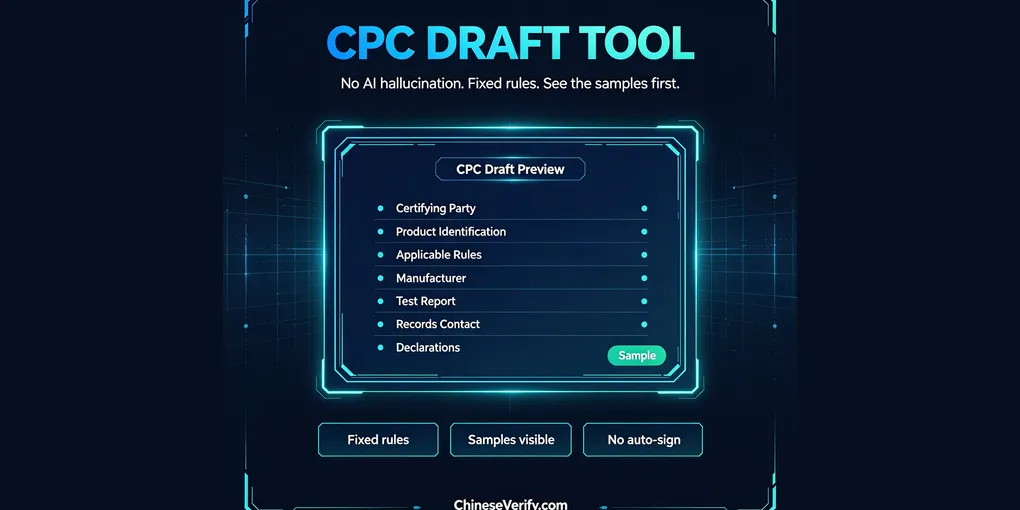
CPC Draft Tool Without AI Hallucination: See the Samples Before You Trust It
It starts with UPS asking for a CPSC document
In early July we got a typical question. A buyer in Malaysia ordered diecast 1/18 alloy car models from a Chinese supplier, HTS 9503. When the shipment reached UPS transit, they were asked for CPSC paperwork and something called a “Product Registry #.” The buyer is an individual, not an importer, and had no idea what to send.
This is ordinary life after July 2026.
Since July 8, 2026, importers of CPSC-regulated products must file certificate data electronically with CBP through ACE (eFiling). The “keep a PDF in the file cabinet” era is over. For buyers, sellers, and small importers without a dedicated compliance person, the problems pile up in three places:
- Hiring an agent is expensive and slow. A certificate often takes days, and every extra day in port costs money.
- Filling it in yourself means facing regulation numbers that look like a foreign language. 16 CFR 1250, 1307, 1501 — which ones apply to your product? Most people guess.
- Letting an AI write it is the most dangerous option. A general-purpose LLM will confidently invent rule numbers that don’t exist. Put a fabricated citation on a certificate and you have a false document. CPSC civil penalties for false or missing certificates can reach up to roughly $120,000 per violation (adjusted for inflation), and a fabricated citation is treated as a knowing violation — not a clerical error.
Our answer is a CPC drafting service with fixed rules, visible samples, and no auto-signing. We don’t ask you to pay and try first — we show you the samples. If they make sense and line up with your product, decide after that.
The tool is at CPC Draft Tool, and the samples are at /report/sample/cpc/.
Why we deliberately don’t use AI to write the certificate
A Children’s Product Certificate (CPC) is a legal self-declaration, not marketing copy. It’s issued by the U.S. manufacturer or importer of record, stating that the product complies with the applicable CPSC rules. “Reads well” is not a criterion.
A general LLM does three bad things in this scenario:
- It treats ASTM F963 as a standalone regulation. The correct citation is 16 CFR Part 1250 incorporates ASTM F963 — F963 is an industry standard that becomes mandatory only through that incorporation. AI routinely drops the “incorporated by reference” layer and lists F963 on its own, which is not how it belongs on a CPC.
- It lists 16 CFR 1501 (small parts) as an independent test item. 1501 is not a separately selectable rule; it’s a derived assessment under the 1250 framework. Someone who doesn’t know this turns the certificate into a pile of rules.
- It misclassifies adult collectibles as children’s toys. If an AI sees the word “toy” on a diecast 1/18 model and files it as 12-and-under, it pushes you to sign a false children’s product certificate. That’s worse than no certificate at all.
So the CPC drafting tool goes the other way:
- A fixed rule dictionary (rules.js). Applicable rules are computed from a manually maintained dataset aligned with the CPSC children’s product framework, version-locked. No model improvising on the spot.
- No auto-decision on CPC vs GCC. The form asks you to pick the intended age (0-3 / 3-6 / 6-12 / up to 12). It does not guess the classification for you. That call depends on the product’s actual use, packaging, marketing claims, and dimensions — facts only you have, not something to be guessed. This is spelled out in FAQ Q9.
- Every draft comes from the same engine as the samples. The samples are not polished screenshots — they are outputs of the same rule engine. Compare a sample against your own product and you can tell we’re not switching concepts on you.
Here’s the difference in concrete terms:
| AI-generated CPC | Our rule engine | |
|---|---|---|
| ASTM F963 citation | May be listed as a standalone rule | Always cited via 16 CFR 1250 |
| 16 CFR 1501 (small parts) | May be listed as a separate test item | Treated as a derived assessment under F963 |
| Adult collectibles | May be misclassified as children’s products | No auto-decision — guides to GCC / CPSC disclaimer |
| Rule version | May use an outdated one | Locked to F963-23 (effective 2024-04-20) |
The seven elements of a compliant CPC (walked through with samples)
The seven statutory CPC elements map to the form’s sections A–G:
| Element | What it is |
|---|---|
| A | Certifying Party (U.S. manufacturer / IOR) |
| B | Product Identification (name / model / SKU / GTIN / dates & place of manufacture) |
| C | Applicable rules (16 CFR rules and standards) |
| D | Manufacturer / production entity |
| E | Third-party test report (CPSC-accepted lab) |
| F | Contact for records of test results |
| G | Declarations and signature |
Three real-scenario samples show where people go wrong.
Sample A: Children’s cotton pajamas (ages 3-6, sizes 2T-6X)
Rules: 16 CFR 1615 + 1616 (children’s sleepwear flammability) + 15 U.S.C. § 1278a (total lead). No 1303 (coating lead) or 1307 (phthalates) listed — 100% cotton jersey with no surface coating or plasticized parts. Not a toy, so no F963.
Where it goes wrong:
- A 2027 production date with 2026 testing — testing has to come first. A reversed timeline falls apart on inspection.
- The lab (Intertek, in this sample) must be CPSC-accepted and accepted for the relevant standard — verify any lab’s status in our CPSC-Accepted Lab Directory.
- The certifier is the U.S. importer of record, not the offshore factory. A CPC has to be issued by a U.S.-based responsible party; a foreign factory cannot be the certifier.
Sample B: Children’s plush toy (100% polyester, 0-3 years)
Rules: 16 CFR 1250 (safety standard for toys, incorporates ASTM F963-23) + 15 U.S.C. § 1278a + 16 CFR 1307. The sample shows F963 as a separate line item marked “industry reference — non-mandatory” to make the citation structure transparent — it is incorporated by reference through 1250, not listed as a standalone CPSC regulation. No 1303 (no surface coating) and no 1501 (no small-parts hazard for this design).
Where it goes wrong:
- ASTM F963 must be cited “via 16 CFR 1250,” not listed as a standalone regulation. The rule engine handles this automatically in the sample; it’s the first thing people miss when filling in by hand.
- The lab (SGS, in this sample) must be CPSC-accepted and accepted for the relevant standard — verify any lab’s status in our CPSC-Accepted Lab Directory.
- Don’t copy rules from another product’s certificate. This toy lists 1307 but no 1303 and no 1501 — the materials and design call for that. 100% polyester, no surface coating, no PVC, no small parts means those items simply don’t apply.
- 1501 is a derived assessment under F963, not a separate checkbox. Whether it appears depends on the actual design, not on guesswork.
Sample C: Adult collectible alloy cars (14+, HTS 9503 misused)
This one gets no CPC. The tool guides you to the GCC route or a CPSC disclaimer instead.
Where it goes wrong:
- The HTS code is not the age test. Classification follows packaging, marketing, dimensions, and safety warnings — not the customs code. HTS 9503 is commonly misread as “toy,” but a 1/18 alloy car model aimed at adult collectors is not a children’s product under CPSC rules.
- Issuing a CPC for a non-children’s product is a false certificate. You’d be signing legal risk onto yourself.
This is FAQ Q10 in action: for these products, you file with your broker as “CPSC Disclaimed — not a children’s product, intended for adult collectors,” or use the GCC tool. For the full adult-product route — rule matching, lab picker, three templates — see our GCC generator feature walkthrough.
All three samples are public — open them and compare. These are real outputs from the same engine that generates your draft, not mockups or AI-generated placeholders:
After the July 8, 2026 eFiling deadline, the draft is only step one
Be clear about one thing: the CPC draft is only step one. Since July 8, 2026, all formal import entries for CPSC-regulated products must transmit certificate data through CPSC eFiling (ACE/PGA message) — either the seven elements or a Reference Registry (Certifier ID / Product ID / Version ID). The PDF is not auto-filed. Note: informal entries (e.g., personal shipments under Section 321 de minimis) are generally exempt from eFiling, but commercial couriers may still request CPC data at their discretion — as many importers discovered in July 2026.
So the tool’s boundary is explicit, and we don’t over-promise:
- ✅ Outputs a structured CPC draft — all seven elements, rule citations aligned with the CPSC children’s product framework
- ✅ Exports PDF / JSON for you or your broker to review
- ❌ Does not connect to CBP / CPSC systems, does not sign for you, does not decide CPC vs GCC for you
The tool states these boundaries in its own FAQ too (Q7 on eFiling, Q8 on why not AI, Q9 on why it doesn’t auto-decide). The responsibility for issuing a valid CPC stays with the certifying party.
Bottom line
A CPC is a legal document. We solve “the draft is fast, the rules aren’t invented, and the samples are visible.” We don’t solve “carry the liability for you.”
Spend three minutes on the samples. Compare the rules and the seven elements against your own product. If they match and it looks useful, spend five minutes filling in the form and generating a draft. If they don’t match, you’ve lost nothing.
The $29 service fee covers the draft generation only. Third-party testing by a CPSC-accepted lab is still required and priced separately by the laboratory.
- See the sample: Children’s Product Certificate (CPC) sample
- Try it: CPC Draft Tool ($29)
- Adult / general-use products go here: GCC Draft Generator
FAQ
Q: What’s the difference between a CPC and a GCC?
A: A CPC applies to children’s products (age 12 and under) and requires testing by a CPSC-accepted third-party laboratory. A GCC applies to adult / general-use products and allows in-house testing under a reasonable testing program (the lab field can say N/A). Children’s products cannot use a GCC.
Q: Does the tool pick the applicable rules for me?
A: No. It computes suggested rules from a fixed dataset aligned with the CPSC children’s product framework, and you review them. The final applicable rules depend on your product design, materials, intended age, and test records.
Q: Why not just have an AI generate the CPC?
A: A CPC is a legal self-declaration. AI hallucinates rule numbers, treats F963 as a standalone regulation, and misclassifies children vs adult products. A false certificate is worse than no certificate.
Q: Does a CPC require a CPSC-accepted lab?
A: Yes. Unlike a GCC, the laboratory identification is one of the seven CPC elements — it cannot be marked N/A. The test must be a real report from an accepted third-party lab — browse the CPSC-Accepted Lab Directory to confirm coverage.
Q: Is the draft filed with CPSC or CBP automatically?
A: No. The tool is not connected to CBP or CPSC systems and only outputs a draft. The eFiling data is submitted by you and your broker through ACE.
Q: How long do I keep the records?
A: CPSC requires supporting records (test reports, reasonable testing program documentation) for at least 5 years from the date the CPC is created. The tool does not store your data — download and archive the draft yourself.
Disclosure: This article is for informational purposes only and does not constitute legal or compliance advice. CPC obligations are determined by 16 CFR Part 1110 and CPSC policy.