What Is a Children's Product Certificate (CPC) and Why Is It Required? A Rule-by-Rule Breakdown
It starts with a container sitting at the port
A shipment of children’s toys leaves Shenzhen, clears ocean transit in 18 days, and arrives at the U.S. port. Then it stops. Not because of customs duties. Not because of a missing commercial invoice. Because CBP’s ACE system is asking for a Children’s Product Certificate — and the importer doesn’t have one.
This is not a hypothetical. Since July 8, 2026, all formal import entries for CPSC-regulated products must transmit certificate data electronically through ACE (eFiling). The “keep a PDF in the file cabinet and hope nobody asks” era is over. If the data isn’t in the system, the container sits.
But here’s the thing most people learn too late: a CPC is not a form you fill out on the morning your container arrives. It’s a legal self-declaration with specific rules, specific requirements, and specific consequences for getting it wrong.
What a CPC actually is
A Children’s Product Certificate (CPC) is a written certification required under Section 14 of the Consumer Product Safety Act (15 U.S.C. § 2063), implemented through 16 CFR Part 1110. It is issued by the U.S. manufacturer or importer of record (IOR), stating that a product intended for children 12 years and under complies with all applicable CPSC safety rules.
Key facts that people routinely get wrong:
- It is not a government-issued certificate. CPSC does not issue CPCs. The agency doesn’t review or approve them in advance. You write it, you sign it, you’re responsible for it.
- It is not optional. If your product is a “children’s product” under CPSC rules, a CPC is mandatory before the product can be imported or distributed in the U.S.
- It is not the same as a GCC. General-use products (adult / 13+) use a General Certificate of Conformity. Children’s products cannot use a GCC. Using the wrong certificate is itself a violation.
Who needs a CPC
A CPC is required when all three conditions are met:
- The product is a consumer product (sold or distributed in commerce)
- It is designed or intended primarily for children 12 years of age or younger
- It is subject to one or more CPSC-enforced safety rules
The age determination follows the CPSC Age Determination Guidelines (16 CFR Part 1200), which look at four factors:
- The manufacturer’s stated intent (packaging, marketing, labeling)
- The product’s physical characteristics (dimensions, features)
- Whether the product is commonly recognized as intended for children
- The Age Grading Guidelines published by ASTM
Common mistake: treating the HTS code as the age test. HTS 9503 covers “toys,” but a 1/18 alloy car model marketed to adult collectors is not a children’s product under CPSC rules. The HTS code is for customs duties, not safety certification. For the adult-product route in full — rules, lab picker, templates — see our GCC generator feature walkthrough.
The seven elements (and where people go wrong)
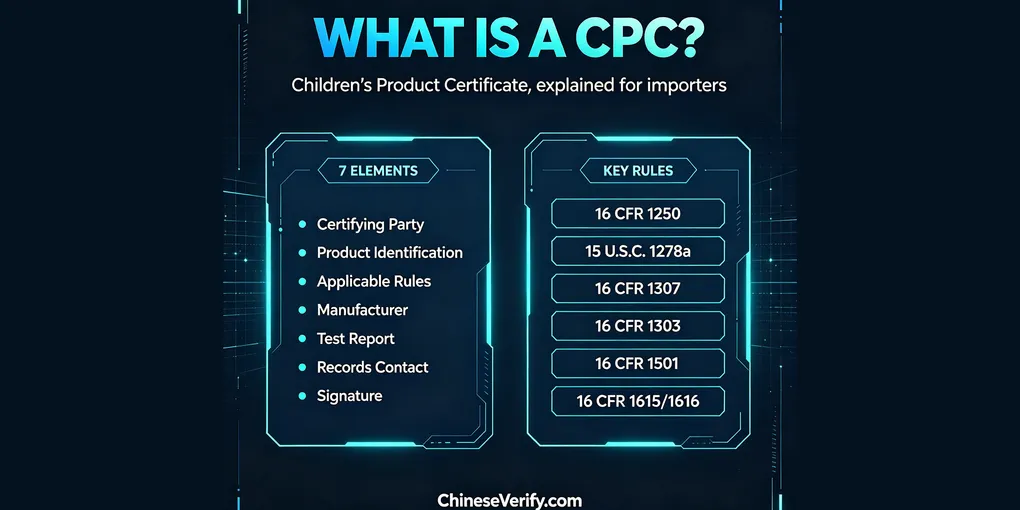
16 CFR 1110.11 lists seven elements that must appear on every CPC. Here’s what each one is and the mistakes we see most often:
A — Certifying Party
The U.S. manufacturer or importer of record. Name, mailing address, phone number.
Where it goes wrong: foreign factories cannot be the certifier. Customs brokers and freight forwarders cannot be the certifier — they only transmit data on behalf of the IOR. If you’re a foreign company selling into the U.S., you need a U.S.-based entity (subsidiary, distributor, or IOR service) to serve as the certifying party.
B — Product Identification
Product name, model number, SKU, GTIN/UPC, production date, place of manufacture.
Where it goes wrong: the information must match the actual product and its physical label. A CPC that says “Model ABC-2025” but ships “Model ABC-2026” is a mismatch — and CBP/eFiling will catch it.
C — Applicable Rules
The CPSC rules and standards the product must comply with. This is the hardest part of the entire certificate — and the one where errors are most costly.
D — Manufacturer / Production Entity
The name and address of the actual manufacturing facility. Recommended for traceability.
Where it goes wrong: listing a trading company instead of the actual factory. If CPSC needs to trace production, they need the real facility, not a middleman.
E — Third-Party Test Report
The CPC must identify a CPSC-accepted third-party laboratory that performed the required testing. This element cannot be marked N/A — unlike a GCC, which allows in-house testing.
Where it goes wrong: using a lab that isn’t on the CPSC’s accepted list (16 CFR Part 1112). The lab must be accepted for the specific standard being tested. A lab that’s accepted for flammability isn’t automatically accepted for mechanical toy safety. Browse the CPSC-Accepted Lab Directory to verify any lab’s status before relying on its report.
F — Contact for Records
The person maintaining test records. Name, mailing address, email, phone. Can be the same as the certifying party.
G — Declarations and Signature
The certifying party signs, declaring that the information is accurate and that testing was performed by a CPSC-accepted lab.
Where it goes wrong: nobody signs it. Or a third party (like a software tool or agent) signs it. The signature must come from the certifying party — the U.S. entity legally responsible for the product.
Applicable rules: the core challenge
There is no universal “CPC rule list” that applies to every children’s product. The applicable rules depend on:
- Product category (toy, sleepwear, crib, etc.)
- Materials (plastic, metal, textile, paint finish)
- Intended age group (0-3, 3-6, 6-12)
Here are the rules that appear most frequently:
| Rule | What it covers | When it applies |
|---|---|---|
| 16 CFR 1250 | Safety standard for toys (incorporates ASTM F963-23) | All toys for children 12 & under |
| 15 U.S.C. § 1278a | Total lead content in accessible parts | All children’s products |
| 16 CFR 1307 | Phthalates in toys and childcare articles | Products containing plasticized materials |
| 16 CFR 1303 | Lead in paint / surface coatings | Products with applied coatings |
| 16 CFR 1501 | Small parts (choking hazard) | Assessed as a derived item under F963 — not a standalone checkbox |
| 16 CFR 1615 / 1616 | Children’s sleepwear flammability | Children’s sleepwear sizes 0-6X / 7-14 |
| 16 CFR 1633 | Mattress flammability | Children’s mattresses |
Three critical corrections that trip up even experienced importers:
- ASTM F963 is not a standalone regulation. It is an industry standard that becomes mandatory only through incorporation by reference in 16 CFR 1250. On a CPC, it must be cited as “16 CFR Part 1250 incorporates ASTM F963-23.” Listing F963 on its own is technically incorrect.
- 16 CFR 1501 (small parts) is a derived assessment, not an independent test item. It is evaluated within the F963 framework. Whether it appears on the certificate depends on the product design — not on a checkbox.
- Material determines the rule set. A 100% cotton children’s pajama needs 1615/1616 (flammability) + 1278a (lead). No 1303 (no coating), no 1307 (no plasticizer). A polyester plush toy needs 1250 + 1278a + 1307. Different materials, different rules — you can’t copy-paste from another product’s certificate.
Third-party testing: non-negotiable
Unlike a GCC (which allows in-house testing under a reasonable testing program), a CPC requires testing by a CPSC-accepted third-party laboratory. This is not a suggestion. It’s written into the statute.
Requirements:
- Lab must be on the CPSC’s accepted list (16 CFR Part 1112)
- Lab must be accepted for the specific standard being tested
- Testing must be performed on the actual product (or a representative sample of the production run)
- Testing must precede the certificate issuance — you cannot test in 2027 for a product manufactured in 2026
The test report is not the CPC. The CPC references the test report. The lab supplies data; the IOR issues the certificate.
eFiling: the 2026 shift
Before July 8, 2026, many importers treated the CPC as a “file-and-forget” document — keep a copy on hand, show it if CPSC asks. That model is gone.
Since July 8, 2026, formal import entries for CPSC-regulated products must transmit certificate data through CPSC eFiling (ACE/PGA message). Two options:
- Full transmission: all seven CPC elements sent electronically
- Reference Registry: Certifier ID / Product ID / Version ID (if pre-registered in CPSC’s system)
The PDF draft is not auto-filed. The data goes through ACE. Your broker handles the transmission, but the data must come from a valid, accurate CPC.
Note: Section 321 de minimis entries (informal, typically under $800) are generally exempt from eFiling. But commercial couriers may still request CPC data at their discretion — as many importers discovered in July 2026 when individual shipments were held at UPS and FedEx facilities.
The cost of getting it wrong
| Violation | Consequence |
|---|---|
| Missing CPC | CBP refusal of admission, product detention |
| False CPC (fabricated rule numbers) | Treated as knowing violation — up to ~$120,000 per violation |
| Wrong certificate type (GCC for children’s product) | Civil penalty + product recall risk |
| Expired/invalid lab | Certificate invalidated, product subject to hold |
| Recordkeeping failure (< 5 years) | Additional civil penalties |
A fabricated citation is not a clerical error. CPSC treats it as a knowing violation because the certifier is asserting compliance with specific federal regulations. If those regulations don’t exist or don’t apply, the certificate is false on its face.
Bottom line
A CPC is a legal document, not a formality. The rules must be correct, the lab must be accepted, the IOR must sign, and the testing must come first. There is no shortcut — and no AI tool should be inventing regulation numbers on your certificate.
If you want to see what a correctly structured CPC looks like, we’ve published three real samples generated by our rule engine — children’s sleepwear, a plush toy, and an adult collectible (which correctly gets no CPC). The samples are outputs of the same fixed-rule system that powers our CPC Draft Tool.
Adult / general-use products go here: GCC Draft Generator
Disclosure: This article is for informational purposes only and does not constitute legal or compliance advice. CPC obligations are determined by 16 CFR Part 1110 and CPSC policy.